Saturday, October 31, 2015

Eyes Without A Face / Le Yeux Sans Visage (1960)


Directed by: Georges Franju
Screenplay: Pierre Boileau, Thomas Narcejac, Claude Sautet, and Pierre Gascar; based on the novel by Jean Redon
Starring: Edith Scob, Pierre Brassuer, Alida Valli, Francois Guerin, Juliette Mayniel
Running Time: 90 minutes


In the 1950’s, the French weren’t known for producing horror films. French cinema, after all, was the home of the New Wave, Goddard, and Truffaut, they didn’t have time for such “artless” movies. But it just so happened that during this decade, a studio in England was finding world-wide success by cranking out that very sort of film that the French had stigmatized. That would be Hammer Studios, and needless to say, when the French film industry saw the way Hammer was raking in cash hand over fist with the likes of THE HORROR OF DRACULA and THE CURSE OF FRANKENSTEIN, they started to have a change of opinion on that so-called “disreputable genre.” “Money talks,” to quote AC/DC. The first producer to jump at this was Jules Borkon, who had purchased the film rights to a novel by Jean Redon titled LES YEUX SANS VISAGE / EYES WITHOUT A FACE and enlisted one of the founders of the famous French film club Cinematheque Francaise, Georges Franju, to direct it. Franju was a documentary filmmaker who had made a name for himself for such reactionary works as THE BLOOD OF BEASTS, PASSING BY THE LORRIANE, and HOTEL DES INVALIDES (which he fondly refers to as his “slaughter trilogy”) and had moved on to making fiction films with LE TETE CONTRE LES MURES / HEAD AGAINST THE WALL, a film set in a mental hospital which was released as THE KEEPERS on our side of the Atlantic. Thing about Franju is that unlike the other notable filmmakers that were members of Cinematheque, who were former film critics who decided to take that old comment section refrain of “Well if you didn’t like it, make one of your own!” to heart, Franju was simply a cinema buff through and through and jumped at it when Borkon offered him a chance to make his own addition to cinema of the “fantastique.”

There were to be some restrictions, Borkon told Franju. While Borkon wanted a horror film that could compete with the blood-spattered gothics Hammer was putting out, the film couldn’t show any real bloodshed. That was would be a big no-no with the French film censors. He couldn’t depict animals being tortured. That wouldn’t fly with the English and Americans. Furthermore, the film could not feature a mad scientist performing horrible experiments on innocent people. The Germans…for obvious reasons. With those set in place, Borkon handed Franju the story of a mad scientist who experiments on animals and kidnaps beautiful women so he can cut their faces off and told him to make a movie out of it.  
 
The film starts with a completely wordless opening that does a marvelous job of setting the tone. It’s night time in Paris and a nervous woman (Alida Valli, the intimidating dance instructor from SUSPIRIA) is driving an old Citroen taxi up to the Seine River, where she dumps a woman’s corpse that she’s had disguised as a passenger in the back seat. The corpse was so completely covered by a trench coat and hat that we can’t get much of a look at her but if we look close enough, we can get a tiny glimpse of her face and whatever has happened to them couldn’t have been pleasant. The next day, respected surgeon Dr. Genessier (Pierre Brassuer) is called away from a speaking engagement by the Parisian police. They’ve found that body that the woman disposed of and there’s very good chance that it could be Genessier’s daughter Christiane, who disappeared following a car accident that ended up horribly disfiguring her. Thing is, the body could also be that of another missing woman, the damage done to her face an attempt to hide her identity. Both Genessier and the missing woman’s father are called in to identify the body, but Genessier gets there first and confirms that yes, it’s Christiane, before leaving to make funeral arrangements. Some of the details don’t completely add up but Genessier’s identification is enough for the police to conclude that Christiane committed suicide and consider the case closed. It’s at Christiane’s funeral, however, that we get the idea that there’s more going on here, because attending with Dr. Genessier is his assistant Louise, who is the nervous woman from the opening. When we look at the way the two of them act when they are alone after the funeral is over, it’s becomes clear to us that that whatever Louise is doing, she’s doing so on Genessier’s orders. It’s when Genessier returns to his home, a mansion located near the clinic where he works, that our suspicions are confirmed: the body in his daughter’s crypt is that of the missing woman and Christiane (Edith Scob) is very much alive. Seems Genessier is responsible for the death of the other woman, who died while he was performing “an experiment” on her. However, the woman’s death ends up working to Genessier’s advantage. By making everyone believe that Christiane is dead, Genessier doesn’t have to worry about anyone, such as her fiancĂ© Jacques (Francois Guerin), stumble across his work in the process of searching for her.

It’s work of particularly grisly sort. Genessier is convinced that a new skin grafting technique that he has developed could restore Christiane’s ruined face, which he has her hide behind a featureless white mask. Problem is, this technique requires a donor that’s close in age and physical appearance to Christiane and needless to say, most young women aren’t going to give up their skin willingly. That’s where Louise comes in, stalking women that fit the necessary body type and luring them to Genessier’s mansion where he can drug them and surgically remove their faces. Louise is horrified by this but goes along with it because she’s grateful to the doctor for restoring her own disfigured face (the sole remnant of which is a tiny scar she keeps hidden with a pearl choker) and because she’s become something of a surrogate mother to Christiane during her time with Genessier. A second woman falls into the pair’s trap and it seems that this time, the facial transplant takes. The second victim obviously doesn’t appreciate receiving the Castor Troy treatment and ends up either committing suicide or falling to her death in an escape attempt, so now Louise and Genessier have another body to dispose of. More troublingly, though, is during dinner a few days later that Genessier begins to notice something has gone wrong with the skin graft. Within a couple of weeks, Christiane’s body rejects it and her father is forced to remove it.


This leaves Christiane on the edge of a suicidal despair and in her desperation, she calls Jacques. Jacques, obviously, is more than a little weirded out by hearing his supposedly dead fiancĂ© calling his name over the phone and goes to the police. While talking with them, Jacque’s catches the description of the woman last seen with missing woman and damned if it doesn’t sound a lot like Louise.  Realizing that this may be the break they need, the police blackmail a shoplifter into acting as bait for Genessier, hoping to catch him in the act. Unfortunately for our poor shoplifter, Genessier is able to cover his tracks well enough to send the police looking elsewhere, and she ends up on the good doctor’s operating table. Now her survival will depend on whether or not Christiane can stand being complicit in whatever crimes her father commits in her name any longer.
Like I said earlier, Franju was put under several restrictions when he was given EYES WITHOUT A FACE, but it’s the sign of damn good filmmaker when they use the limits placed on them to discover the considerable spaces they can work in.  To deal with the whole “mad scientist” angle, Franju and his screenwriters (which included the writing duo behind DIABOLIQUE and Hitchcock’s VERTIGO) made a notable change from the novel: moving the story’s focus away from Genessier and put more emphasis on Christiane. Doing so ends up having the effect of helping us understand more why Genessier is willing to do such horrible things. See, the key detail here is that it was Genessier who was driving (“like a lunatic”) when the accident that disfigured Christiane occurred and the distraught young woman blames him for it. It’s the anguish brought about by his love and guilt that drives him to such extremes and had Christiane not stopped him would have likely lead him to continue butchering woman in his pursuit, unable to admit that his technique may not work and there could simply be no hope for her. What we have then, is a mad scientist movie where the mad scientist isn’t mad, but haunted. (It’s no accident, that Christiane, dressed all in white and wearing that unnervingly serene looking mask, is every bit the ghost you’d find roaming the halls of some decaying old gothic estate.) I think it’s telling that when EYES WITHOUT A FACE was released in the United States under the thoroughly blunt-instrument title of THE HORROR CHAMBER OF DR. FAUTUS (Really guys? Dr. Fautus?) the only scene removed had nothing to do with any of the film’s violence but a moment in where we see Genessier comforting one of his patients, a little boy, and his distraught mother. Apparently we’re fine with showing people being monsters but God forbid we have to deal with the uncomfortable truth that monsters can have a human side as well.
 

With that one major change from the source, one of the hurdles Franju had to deal with was overcome and the animal experimentation aspect of the story wasn’t that difficult to work around either. We see that Genessier has numerous stray dogs, some covered in bandages, locked up in part of his hidden lab and we see one after he’s experimented on them. It’s nothing too messy and tells us all we need to know, so nothing to get upset over. Which leaves us with how the bloodshed was going to be handled. Make no mistake, EYES WITHOUT A FACE is a violent movie. This is after all, a movie about a guy cutting women’s faces off. But there’s a reason why decades later, after advances in special effects technology and relaxing of restrictions on violent content would have dulled the edge of other movies, it’s still so incredibly effective and squirm inducing. A lot of that, I think, comes from the fact that EYES WITHOUT A FACE is just so low-key and quiet of a movie. Its tone is somber and melancholy (in that way that only the French can do) and the film goes long stretches without dialogue. Couple that with the fact that we’ve probably conditioned ourselves to not expect to see somebody get a scalpel in the throat or their face chewed off by dogs in a black and white movie from the time, and so when the shocks come, they’re genuinely shocking, like a slap to the face. Furthermore, as noted earlier, Franju made documentaries before he moved on to film; his first, THE BLOOD OF BEASTS, being about the inner workings of Parisian slaughterhouse. In an interview excerpt that came on the Criterion disc, Franju also discusses how the single most horrific film he ever watched was footage of a trepanation being performed on a conscious patient with a brain tumor. You can definitely see how both informed his approach here, as the whole film is shot with the kind of clinical detachment you’d find in a medical documentary. This level of remove, I feel, was a major factor in getting the film past the censors, however, in terms of how it affects the views, it has the opposite effect of what you’d think. It forces us to face (no pun intended) the violence being done rather than disengaging from it. I’m not surprised that people at screenings were actually fainting when EYES infamous face surgery scene came along. It’s excruciating to watch, poking and prodding at every subconscious nightmare that we’ve had about going under the knife and we’re with it every single step. The scene is probably even worse, if, like me, you’ve had family members hurt by a botched surgery. Really, this where a lot of the horror in EYES stems from. Vitally important as it is, Franju is forcing to face that there can be something dehumanizing and wrong feeling about medical science. (Part of the reason hospitals creep me out.) Take a look at that contraption the shoplifter gets hooked up to test her brain patterns. Or most effectively, how about the scene that details the deterioration of Christiane’s condition when the graft fails via a photographic montage. The calm manner in which Dr. Genessier throws out such gruesome sounding terms as “heterograft,” “ulceration,” and “necrosis” as we see Christiane’s face get worse and worse would be bad enough without the added touch of this being a father talking about his daughter’s face rotting off. Brrr… You’d likely have to turn to David Cronenberg to find anything that does as good a job of tapping this vein of medicinal horror.

EYES WITHOUT A FACE was met with considerable controversy on release; critics who didn't condemn it outright either having to jump through hoops to justify their appreciation, one English critic nearly getting fired for praising the film and another famously arguing that a respectable French filmmaker couldn't have made something disreputable as a horror film and EYES WITHOUT A FACE was actually a film noir. Anyone else getting flashbacks to SILENCE OF THE LAMBS'S magical transformation into a "psychological thriller" once it was nominated for Oscars? But, as with a number of films that stir up the hornets nest because they force people outside their comfort zone, it has endured and influenced a number of filmmakers sense. I've never heard Cronenberg talk about this film but it stands to reason that he'd be a fan, right? You can chalk it up to this film and that shot with Christiane and the doves as the reason why there's a scene involving birds in the every damn John Woo movie. Can't blame him, it's a fantastic image. John Carpenter was so taken with Edith Scob's eerie, spectral performance that it influenced the creation of his own faceless wraith, Michael Myers. (One a remnant of humanity, the other completely void of it.) Maybe, it's because I saw it in the same weekend as CRIMSON PEAK that I could trace the influence of this film's use of sudden intrusions of violence to Guillermo Del Toro's. Hell, it was Del Toro's recommending the film on twitter that finally motivated me to check it out.  (P.S.: Go see CRIMSON PEAK. It's good!) If what they say about imitation and flattery is true, well, notorious Euro-sleaze director Jess Franco is a huge fan, as he spent a good chunk of his career making the like of FACELESS and THE AWFUL DR. ORLOF that are remakes of EYES in all but name. Could explain why I'm not too hot on the American title, sounds a little too much like one of Franco's knock-offs.


Once you see it, you'll understand why. EYES is one of those films that sticks with you after its over. It ends rather abruptly, with Christiane's fate unknown, and some people may be off-put by that. For me, after mulling it over for a day or two, I found that I actually am quite fond of its ending. Strange to say about an ending that features a young woman turning against and killing her family but bear with me. While EYES'S conclusion isn't what you would call uplifting, I do feel that there's a hopeful message at the heart of it. A lot of it has to do with Jacques final scene. Believing Christiane truly gone forever, Jacques decides to move on, with one of the detectives commenting that he's young and has his whole life ahead of him as he departs. To me, that's what EYES WITHOUT A FACE is really about. The events of the past change us, tragedies harm us, and we will carry the effects of that forever. There's no going back and "fixing" that. Dr. Genessier and Louise tried that and look where that got them: they became murderers and ultimately were destroyed by the very person they damned themselves for. The best thing you can do is pick yourself up, move on, and live your life. even if it means facing an unknowable future.


A Little Something Extra:
What? You thought I was going to post that Billy Idol song? Now, I would have gone with "Eyes Without A Face" by The Flesh Eaters from THE RETURN OF THE LIVING DEAD soundtrack but after giving it a listen, I realized it wasn't my particular favorite song from that; so the hell with it, here's "Surfin' Dead" by The Cramps. Remember folks, life is short and filled with stuff.


"The Rats" by James Herbert


Early on in DANSE MACABRE, Stephen King tells this anecdote about the writing of his vampire novel SALEM’S LOT where, in the first draft, one of the characters meets a fairly unpleasant end at the teeth of a swarm of rats loosed on them by king vampire Barlow. In his words, King had wanted to riff on a similar moment in Stoker’s DRACULA but add a gruesome E.C. Comics touch to the proceedings, and was gleefully happy with the result. However, King’s editor, Bill Thompson, found the scene to be so revolting he asked for it to be changed in subsequent rewrites, with the character instead biting it when he sets off a booby-trap on a stairway. A nasty way to go, but not as spectacular as his earlier demise - a “middle-of-the-roader” as King puts it - and the change had the effect of leaving the build up to that, repeated mentions of the number of rats infesting the town, with no real pay-off.

I wonder what ole Bill would have made of James Herbert’s debut novel, THE RATS?

There’s not as much of a leap between the two books as you’d think. Stoker’s DRACULA was the key inspiration for both and in fact, it was that very scene King was putting his own disgusting spin on that sparked Herbert’s novel. But whereas King’s novel is a good, hefty sized volume - maybe not the doorstoppers IT and THE STAND were, but still clocking in at over six hundred pages – Herbert’s is a speedy little shocker that comes in at around a third of LOT’s page count, the kind of slim paperback that you could slip into your back pocket and carry around all day, for whenever you find a quiet corner and moment to yourself. (Those are the best kind, aren’t they?) And while King was using DRACULA as a template so he could dig into what might happen if the Count had found his way to an American small town, Herbert, the son of street traders from London’s East End, used it as a jumping off point to put a voice to his frustration at how the powers-that-be were letting his old home fall into ruin. Simply put, the events of THE RATS could have been avoided had the city not left an old house to rot.

The plot is as straight-forward as they come. There are these swarms of bigger-than-normal rats running around London eating people. Any survivors who have been bit will die painfully within twenty four hours from a virus that the rats are carrying. Someone has to put a stop it and of course, that job falls into the lap of Harris, an art teacher whose student was among the first victim of the virus. What? You thought the authorities were going to do it? They’re the ones that gave the rats their breeding ground by neglecting the bombed out buildings around London, or the homeless problem, which is how the nasty little buggers got their first taste of human flesh. No, it’s only with the help of our working class hero with no first name (I’ve read this book twice and never spotted one) and the kind of anti-establishment streak that has him locking horns with and ready to slug any authority figure that he meets that The Man is able to get anywhere with combating this menace before it wipes the entire city.

As you can tell, THE RATS is nestled very firmly and proudly within old-fashioned B-movie, pulp horror territory of the nature / science gone amok branch. We never get a description of Harris but it’s easy to picture him as the sort of virile looking, broad shouldered, square jawed manly man we associate with these stories. Scientists are here to spout off jargon, suggest solutions and then get the hell out of the way so men of action can take over and save the day through applications of violence and mule-stubbornness, usually after the initial attempt to stop the threat fails or even makes it worse. Women are um…here…basically, though of course, the only one who has any major role outside of potential rat fodder is Harris’s lovely girlfriend, Judy, she of no last name. Even that old monster movie boogeyman Atomic Radiation sticks its nose in with a near blink-and-you’ll-miss-it suggestion that these killer rats were spawned from mutants originating from a nuclear testing site. THE RATS is very much aware of its pedigree, as two of its set pieces, an attack on a school and one at a movie theater, feel like deliberate nods to THE BIRDS and THE BLOB. (Even the title is suggestive of such.)

You wouldn’t have found the level of graphic violence and explicit sex in those old B-movies that you do in Herbert’s books, though. Imagine one of those old flicks having a gruesome baby with a considerably harsher horror film of the post-NIGHT OF THE LIVING DEAD –era or a step between classical horror and the splatterpunk movement. Getting back to DANSE MACABRE for a moment, in his segment on Herbert and Ramsey Campbell, King accurately describes Herbert as “putting his combat boots on and assaulting the reader with horror […] …seizing us by both lapels and screaming in our faces.” A writer that has gone on record stating he loves to see how much he can get away with, Herbert is willing to charge full-bore into some very unpleasant places. This is, after all, a book about people being devoured by a swarm of disease carrying vermin. Herbert is clearly having a blast playing with our old fear of cloth and skin not being much of a defense against teeth and smashes fiction taboos about what’s okay and what’s not early. Within the first twenty pages, a baby and the dog protecting it fall victim to the rats, a scene that got Herbert in trouble in his home country, one reviewer saying that that the book was enough to make a rodent retch. While the remainder of THE RATS never quite matches that mean spirited shock, it still manages to sustain a level of nastiness comparable to some Italian gore flicks. A good part of the motivation to keep reading is seeing not only whether or not he’s going to go there but how.

What THE RATS lifted from those old movies most successfully was the pacing of those drive-in monster films. This is a book that moves, never letting the action lull for a moment. There are probably two chapters out of the twenty that don’t deal with the menace of the rats. If it looks like one of those lulls is coming, Herbert just takes the camera off his main characters for a moment and switches to a minor character for a little side vignettes, usually a few pages of back story and “…and then they got ate by rats” as the denouement. The episodic chunks are actually fairly successful at giving the reader a cross-section look at what life was like in post-war London and helping us grasp that there’s an entire city in danger, not just our Chuck Meatslab hero and company. It’s this refusal to let things lag for too long, coupled with our desire to see where he’s going to take it, and its short length that makes THE RATS such a quick, exciting read.


However, if you’re interested in checking out Herbert’s work, I wouldn’t call it the best place to start. That would be the first Herbert novel that I read and his second written, THE FOG. (No connection to the John Carpenter’s movie.) Reading THE RATS afterward, it feels like something of a dry run for THE FOG; an amorphous threat, similar cast of characters and story structure, as well as the same reckless abandon in regards to its content. But the scope of THE FOG is grander and the characters are given a tiny bit more weight. The nature of THE FOG’s threat, an insanity causing microbe, is also more interesting one than THE RATS swarm. There are, after all, only so many ways you can describe people fighting against rats crawling all over them before such scenes start to sound the same. Again, a reason the short length plays into its favor. When THE RATS reaches that point, its ends soon afterward. THE FOG on the other hand, is able to throw out such varied and memorable horrors as a entire town committing suicide, man-eating pigeons, and a whole class of murderous school children. (Also, THE FOG doesn’t have a moment where its main character ogles one of his young students. Seriously, ew.) Once you’ve read THE FOG, THE RATS is as good a place as any to go next. Despite the backlash he got from it, THE RATS was successful enough that Herbert wrote two sequels to it. The first, LAIR, sounds a little too much like THE RATS…AGAIN to really interest me, but I’ve seen someone describe the third post-apocalyptic installment, DOMAIN, as “George Romero’s DAY OF THE DEAD with rat monsters.” Now that I’ve got to check out.

There was a film adaptation of THE RATS, but not a particularly faithful one. (According to the screenwriter, he didn't really read the book and instead just ripped off PIRANHA.) It's worth checking out, though, because the way they went about portraying the rat swarm is somewhat infamous...and adorable. Would you like to know more? Hop over to Checkpoint Telstar for Tim's review of DEADLY EYES.

You've Got Red On You


AN AMERICAN WEREWOLF IN LONDON (1981), Dir: John Landis


Sunday, September 27, 2015

An American Werewolf In London (1981)


Director: John Landis
Screenplay by: John Landis
Starring: David Naughton, Griffin Dunne, Jenny Agutter, John Woodvine, Brian Glover
Running Time: 97 minutes
Tagline: "From the director of ANIMAL HOUSE...a different kind of animal."

"Beware the moon, David."


AN AMERICAN WEREWOLF IN LONDON came to Landis in a moment that sounds like it could have been the opening of a werewolf movie itself. It was 1969 and he was working as a production assistant on KELLY’S HEROES in Yugoslavia. While being driven to a shooting location in the countryside, Landis witnessed a burial being performed at a crossroads by a group of gypsies. The man being buried was done so feet first and had his body wreathed with garlic. When Landis inquired as to why he was being buried in this manner, his driver informed him that this was to prevent the man from rising from the dead. Wondering what would happen if the man didn’t stay in his grave was all that it took to send Landis on a writing jag, resulting in a script that was a contemporary update of THE WOLF MAN. Had things gone as planned, WEREWOLF would have been the follow up to SCHLOCK!, Landis’s 1971 debut feature. It was going to be his second collaboration with special effects and make-up man Rick Baker, who created SCHLOCK’s ape-suit and Landis, correctly, thought was just the guy to pull off this ambitious idea he had for how they would approach the werewolf’s transformation scene. Things had to be put on hold, however, due to studios not wanting to pony up the funds it would have cost and furthermore, not understanding how to sell a movie that was too horrific to be a comedy and yet too comedic to be a horror film. So, onto the back burner it went and there it remained for a nearly a decade, until the success of ANIMAL HOUSE and THE BLUES BROTHERS gave Landis the clout he needed to get the project off the ground. That Rick Baker had worked on this small, independent movie called STAR WARS in the interim probably didn’t hurt, either.

Two American college students, David Kessler (David Naughton) and Jack Goodman (Griffin Dunne), are backpacking across north England when they come across the sleepy village of East Proctor on a stormy night. The place makes a rather ominous first impression; what could charitably be called the center of town is dominated by an Angel of Death statue and the local pub carries the rather uninviting name of The Slaughtered Lamb, its sign depicting a severed wolf's head impaled on a pike. ("Where's the lamb?") But the boys are cold, hungry, and could use a rest, so despite their misgivings, they head inside. Once there, they run into the expected throng of suspicious-of-strangers types you find populating sleepy English villages in this sort of movie, and when Jack inquires to the purpose of a five pointed star on the wall,"The sign of the wolf man" according to him, they're asked none politely to move on. Their departure sparks an argument among the bar patrons, with some saying that they've just committed murder by sending the boys out on this particular night before the village leader (Brian Glover) shuts them all down with the usual "outsiders shouldn't be stickin' their nose into our business" spiel.  Besides, they reason, the boys will be alright as long as they obey the cryptic warning to stay on the road, steer clear of the moors, right? Maybe nothing will happen...

Almost as if it that was its cue, something that sure as hell isn't a dog cuts loose with a very unpleasant sounding howl. The creature, a hulking beast that looks like a shaggy bear with canine features, chases the boys down, tackles Jack and rips him to pieces before David can come to help, and all that little act of bravery earns him is some teeth in his shoulder. The villagers, finally deciding they don't want the boys' blood on their hands, intervene and shoot the creature dead. Before David loses consciousness, he catches a glimpse of their attacker, which, strangely enough, is now a naked man.


David comes to in the hospital and discovers that weeks have passed. Jack's body has already been shipped back home and buried. Confusing David even further is when officials question him about the attack and he discovers that several witnesses blame it on an escaped lunatic. David's claims that his friend was killed by a monster are dismissed as the ravings of someone who's just been through a very traumatic event. That would be all she wrote, but David's having these dreams, you see: real vivid ones. Ones where monsters are killing his family or he's going through some form of transformation. Then there's the visit from his good buddy, the dearly departed Jack Goodman, Jack, who now looks like he's been thrown face first into a threshing machine, informs David that they were attacked by a werewolf. Seeing as David survived the werewolf's attack, the creature's curse has passed onto him and as long as the bloodline of the werewolf lives, Jack is condemned to walk the earth as a ghost, unable to pass on. As much as for wanting to save his friend from the cruel fate in store as he is wanting to be free from his own horrible unlife, Jack urges David to kill himself before the full moon rises.

If there's one bright spot for David in this whole mess, it's the Florence Nightingale-esque romance he's struck up with Alex (Jenny Agutter), the nurse who has been serving as his primary caregiver during his recovery. It's a testament to the actors and the filmmakers that they're able to sell us on this relationship despite it developing so fast, so we don't bat an eye, much, when he goes home with her once he's discharged. (And hey, it's Jenny Agutter.) The two sleep together that night but David's good mood doesn't last, because Jack makes a return appearance looking much worse for wear, and again warns him of what's coming. Up until now, David's been able to convince himself that everything; the monster, the dreams, Jack's ghost; was all in his head but he's beginning to question that. He won't have to wait long to get a definitive answer. The full moon is tomorrow night.


If you’re going to discuss AN AMERICAN WEREWOLF at any length, you’re almost required to discuss that other werewolf movie that opened in 1981 and also featured a totally boss transformation sequence, Joe Dante’s THE HOWLING. They’re practically joined at the hip at this point. I had even planned on reviewing both movies in one go for this blog entry, only to find my copy of THE HOWLING had deteriorated to the point of being unplayable. Despite the close proximity of their release dates, the two movies are pretty dramatically different. LONDON is a fairly traditional werewolf story by design, adhering close to the template established by THE WOLF MAN. We’ve got the male American outsider in a foreign country, the mysterious societal outliers for whom the patient-zero werewolf is their dirty little secret, transformations that come with the full moon, and our hero’s doomed love with a local girl. Only deviation from the norm here is that silver isn’t necessary to kill him (good ole buckshot will do just fine) and there’s no old lady with a thick accent to proclaim “the way you walked was thorny…” THE HOWLING, on the other hand, wants to put as much distance between it and Lon Chaney Jr. as it can; portraying werewolves as a secret society of competing factions and philosophies, tossing out any overt supernatural elements, and picking up the ball and running with the Freudian and sexual underpinnings of the werewolf archetype, all while skewering mental health fads and the news media culture in the process. (I saw someone describe THE HOWLING as the closest thing we'll get to a Brian DePalma werewolf movie and can only nod.)


Both were noted for their pitch-black humor, but THE HOWLING approached that through inside jokes and satirical touches, while AMERICAN WEREWOLF goes broader and more absurd, it's success laying in knowing exactly how to utilize that mixture of comedy and horror that so confused studios and later critics; when to contrast imagery and tone and when one needs to intrude on the other. Think of David's dream where he sees his family butchered by shrieking, monster headed Nazis while The Muppet Show plays in the background. The image is so over-the-top and bizarre that it's certainly amusing, like escapees from a creature feature crashed into some Family Ties-style sitcom, while at the same time...Holy Shit, right? Or the scenes late in the film where he sits in a theater with a particularly naff porno playing, surrounded by the bloody shades of his victims, all of whom are suggesting any number of methods he can use to kill himself in chipper tones of voice. It also helps that WEREWOLF knows when to pull back and let one aspect take over completely. The moments that are just straight comedy, like David having to escape from the zoo after waking up naked in the wolf's enclosure are legitimately hilarious. ("A naked American man stole my balloons!") Then, scenes that focus entirely on horror, such as the initial attack on David and Jack or a transformed David stalking his victims, still effectively generate a palpable amount of tension even after any number of repeat viewings. (I watch this flick at least once a year around this time, for obvious reasons.) The distance between terror and laughter isn't as far as many people think, and the best horror comedies like this or RETURN OF THE LIVING DEAD, know how to use one to underline the other. It doesn't hurt either that AN AMERICAN WEREWOLF may be the most quotable skinwalker flick, some of its best lines coming from the banter between David and Jack's ghost. ("Have you ever talked with a corpse? It's boring!" "I will not be threatened by a walking meatloaf!" "He is your good friend, whereas I am a victim of your carnivorous lunar activities!")


If there's one thing that both AN AMERICAN WEREWOLF and THE HOWLING have in common it's the major shifts they represented in the werewolf genre. The biggest one being that, after these two movies, just dissolving between shots of an actor with more hair glued to his face wasn't going to cut it for a transformation anymore. Special effects technology had finally reached a point where you could show the hair grow, claws sprout, the limbs and face distort, selling you on the idea that yeah, changing into a completely different species was horrifying and painful to watch. Horror fans will debate 'til kingdom come which movie had the better wolf-out scene but neither are anything to sneeze at. Coincidently enough, Rick Baker was attached to do the effects work for THE HOWLING but decided to jump to WEREWOLF due to his earlier commitment to Landis, handing Dante's movie off to his protĂ©gĂ©, Rob Bottin. I'd say things worked out for both. THE HOWLING made Bottin's career and opened the door for projects like THE THING, ROBOCOP, and TOTAL RECALL and Baker received the first Academy Award for Make-Up Effects thanks to WEREWOLF. (Presented by Vincent Price!) Thirty odd years later, they still impress, WEREWOLF's even more so because it makes no effort hide it through dim lighting or excessive editing. Landis had complete confidence in Baker's skill and lets the audience linger on every detail.


Not only did these two films change the way in which the werewolf's transformation was depicted, but the werewolves themselves. Before then, the popular image of the werewolf in cinema was Larry Talbot stalking through a fog shrouded forest in the shadow of his family castle. I can't think of too many werewolf films before these that used a then modern urban setting as its backdrop; moving away from the moors so its creature can run down its prey in subway stations or the seedier side of Los Angeles and cause all manner of carnage at Piccadilly Circus. But more importantly, after 1981, filmmakers finally got it into their head that maybe it was high time that werewolves started looking like wolves, damn it. Now, werewolves weren't just some brute with fangs and a mighty need for a wax job but gigantic hellhounds and towering wolf-headed bipeds. Even designs which were meant to evoke the older form would incorporate aspects of these new ones, i.e. THE MONSTER SQUAD. 'Bout time.


There’s one more thing I’d like to discuss about AN AMERICAN WEREWOLF before I close out this post, something that stuck out at me when I re-watched it for this review. Now, we’re all familiar with the various spiels about what fears your classic monsters represent, right? The vampire is unrestrained sexuality, zombies are the inevitability of death and societal decay through conformity, etc. etc. Our good friend the wolf man? Loss of control. Giving in to your subconscious primal impulses. The Old Adam, as Stephen King calls it in his treatise on the horror genre, DANSE MACABRE, which is a phrase that I love and so badly want to use as a title for a horror story that I’ll probably never write. The beast beneath the skin is the go to supernatural archetype for stories about someone’s bad side coming out to play and has been used as such for everything from abusive relationships (an episode of BUFFY THE VAMPIRE SLAYER) to young girls going through puberty. (GINGER SNAPS) What I find interesting though, is how rarely lycanthropy is used in fiction and film in connection with mental instability, especially when so many stories of it from history and folklore come across sounding a lot like a person suffering from that. Just ask Nebuchadnezzar. THE WOLF MAN touches on it a bit, but in the end, that’s simply Larry Talbot desperately trying to find a rational explanation for what is happening to him. THE WOLF MAN is too straightforward a movie for the connection between the two to take. THE HOWLING definitely plays around with it, what with its setting being a mental health care retreat that its beasties use as way to hide in plain sight while learning to keep their animal side under control. Werewolf rehab, if you will. But in the end, its focus remains primarily on the tried and true angle of werewolf as the monster from the id. (No, not that one.) Discussing this with some of my fellow movie buffs, the only movie that uses werewolves explicitly as a metaphor for mental illness we could name was one of the GINGER SNAPS sequels. In that, it’s basically a medical condition and if the main character doesn’t get the medicinal herbs she needs to keep it in line, she starts self-harming and doing other things that you often see in cases of people who need treatment for depression.


What does this have to do with AN AMERICAN WEREWOLF? Well, look at what David experiences through the whole movie. He suffers from nightmares and hallucinations so frequently he begins to wonder what is real and what isn’t. He struggles with suicidal impulses. When he transforms into his wolf form, he blacks out and has no memory of anything that he does. Alex and David’s doctor certainly don’t buy into any of this talk of werewolves but they certainly believe that David is in a state where he could be a harm to himself or others. And consider that what starts this is seeing a close friend get killed horribly before he himself is badly injured and put into a coma. I don’t know about you guys but I’ll be damned if this doesn’t read like some of the more extreme cases of Post-Traumatic Stress Disorder. AN AMERICAN WEREWOLF does a fantastic job of making you experience its main character’s disassociation with reality, with only its repeated cuts to the perspective of other characters preventing it from being on par with say, MIRACLE MILE, in that regard. What’s surprising about this and a good indicator of how sometimes the end result can get away from a creator’s intentions is that I don’t think that was exactly what Landis and company were going for. The reoccurring instance of David waking up from dream after dream until you’re left unsure whether what he’s seeing is real or not, Landis admits, was something he lifted from a Bunuel film that achieved a similar effect through that motif. You also have to account for how much AN AMERICAN WEREWOLF draws from THE WOLF MAN, so of course, it would feature characters blaming what’s happening as the result of the protagonists fractured mind. Then there’s the fact that in interviews with Landis and Naughton, they show that while they did think of David’s condition in terms of a disease, it was a physical sickness, not mental, they approached it as, playing him as someone who refused to face that he has a terminal disease. So, as it turns out, the most effective “werewolf-as-mental-problem-stand-in” story may have been the result of an entirely coincidental combination of influences and shooting close to the mark, with what we understand about the werewolf represents filling in the blanks as necessary. 


This review was part of the Celluloid Zeroes ADULT ONSET LYCANTHROPY ROUNDTABLE. Want more? Head over to Checkpoint Telstar for Tim's review of THE BAT PEOPLE, or maybe stop by The Terrible Claw Reviews for Gavin's opinion on SSSSSSS. Still not enough? Cinemasochistic Apocalypse bites into the samurai werewolf flick (!!) KIBAKICHI, 3-Beer Theater is inflicted with THE CURSE OF THE BLACK WIDOW, The Tomb of Anubis takes on ROMASANTA, Las Peliculas de Terror deals with a were-cicada infestation with THE BEAST WITHIN, and Web of the Big Damn Spider goes back to SUMMER SCHOOL.


Sunday, September 13, 2015

Miracle Mile (1989)


Y'know, considering MIRACLE MILE's subject matter, whoever decided on "A Welcome Blast!" for the pull quote there needs to be sat down and given a good talking-to. 

Director: Steven de Jarnatt
Screenplay by: Steven de Jarnatt
Starring: Anthony Edwards, Mare Winningham, John Agar, Lou Hancock, Robert DoQui, Denise Crosby, Mykelti Williamson, Kurt Fuller, Brian Thompson, Earl Boen
Running Time: 88 minutes
Tagline: "There are 70 minutes to the end of the world. Where do you hide?"

You won’t realize it the first time you watch it, but MIRACLE MILE’s opening is a fantastic piece of misdirection. It introduces us to geeky jazz musician Harry Washello overlooking the city of Los Angeles as he’s playing his trombone and gazing longingly at a picture of his newfound love, Julie Peters. Harry’s narration establishes that this scene is taking place in media res and we’re settling in for his recounting of how he and Julie first met and the whirlwind romance that follows. Going by the rules of your standard cinematic romance, we’d eventually circle around to that opening moment again somewhere between the tearful break up and whatever crazy stunt Harry is going to pull to win Julie back. However, MIRACLE MILE, as it turns out, is most definitely not your standard movie and more importantly, we never return to that opening scene at any point. It leaves you wondering whether or not that happened or if it’s the film asking “What could have been?” Is this where things would have gone if they had played out as expected and Harry and Julie’s lives not been completely disrupted? Who knows? But it makes it clear that MIRACLE MILE loves to mess with you, leading you in one direction before gleefully sending you hurtling down another.

Pausing to note how eerily prophetic the backdrop for it is going to ultimately be, we see Harry (Anthony Edwards) and Julie (Mare Winningham) have their regulation meet cute during a tour of the La Brea Tar Pits’ George C. Page museum. Harry admits he’s never been one to have much luck with the ladies so you can imagine his elation at how well he’s hitting it off with her. The two end up spending the whole day together; attending a charity concert that Harry’s playing at, buying lobsters from a restaurant and releasing them back into the ocean (“FREEDOM! HORRIBLE FREEDOM!”), rides on the carousel; the usual quirky boy-meets-girl montage. Only an awkward encounter with Julie’s estranged grandparents (John Agar and Lou Hancock) puts a bit of a damper on the good mood but doesn’t stop Harry and Julie from making plans to go dancing later that night, right after Julie’s finished her shift at the diner where she works. Unfortunately, a freak accident knocks out the power in Harry’s building, meaning his alarm doesn’t go off when it’s supposed to and by the time he makes it to the diner, a heartbroken Julie is long gone. Desperate to explain himself and make things up with her, Harry calls her on the pay phone outside the diner but only gets her answering machine. Before Harry can head back into the diner for an early breakfast, the phone rings again and he jumps on it, hoping that it’s Julie.

It ain’t Julie and this is where MIRACLE MILE really shifts gears and gives us the biggest tonal swerve in a movie this side of DUCK YOU SUCKER and FROM DUSK ‘TIL DAWN.  The panicked voice on the other end belongs to a soldier stationed at a missile silo somewhere in North Dakota who dialed the wrong number trying to get in touch with his father in Orange County. From what Harry can decipher of his frantic ravings, something’s gone wrong and the warheads have been launched. In fifty minutes, they’re going to hit Russia and in an hour and ten minutes, the U.S.S.R’s retaliatory strike will hit L.A. At first, Harry is convinced that he’s the victim of a random prank caller, but when he hears the sound of gunfire and a sinister voice tells him to ignore everything he’s heard and to go back to sleep, he realizes this may be the real thing after all. World War III could very well be on its way and convincing anyone of this and more importantly, getting to Julie so the two of them can get the hell out of Dodge, becomes Harry's number one priority. From here, MIRACLE MILE switches over to real-time for its last hour and ten minutes and takes on a hazy, fever dream-like feel, as though we've become trapped in Harry's rapidly escalating nightmare. The film will play its cards close to its chest, leaving you wondering for much of its running time whether the phone call is real or if Harry, in his own words, is being another Chicken Little, kicking over dominoes and causing chaos in the lives of those he comes across. When we finally do get a concrete yes or no answer to what is going on...well, you'll have to see for yourself.

The switch over from a sunny romantic jaunt to paranoid end-of-the-world thriller is a difficult trick to pull off, so credit to writer / director Steven De Jarnatt for doing so without a solitary hitch. He penned the script for MIRACLE MILE in 1978 but despite the positive response to it, his refusal to change the ending meant he couldn't get it produced for nearly ten years. (At one point it was going to be a segment of the TWILIGHT ZONE movie.) This delay may actually have worked out in MIRACLE MILE'S favor, however. The film's 1989 release date, right in the ending stretch of the Cold War, makes MIRACLE MILE feel like an exclamation point, a final word on the past decade. Here's everything we were in the eighties; here's how bloody terrified we were that it was all going to be gone in an instant, swept up in a nuclear fireball courtesy of the U.S.S.R. Though the two film's are wildly different in terms of tone and approach to storytelling, I can't help but be reminded of John Sayles' THE BROTHER FROM ANOTHER PLANET. Both are snapshots of an incarnation of a major city that no longer exist; pastel-and-neon Los Angeles for MILE; seedy, graffiti covered New York for BROTHER; their protagonists' odysseys cross-sections of the lives and experiences of the different people who inhabited them. I would have loved to have visited these places; wandered their streets just to see what I could see. Money, distance and the passage of years have made that hard if not outright impossible, so I'm much obliged when I can find a movie that captures a place and time so vividly you feel like you could crawl in the screen and live there.

(Keeping with the whole "snapshot" idea, I enjoy how the film's cast features a plethora of recognizable faces from eighties pop culture. Not only Anthony Edwards, who was coming off the success of REVENGE OF THE NERDS and TOP GUN, and Mare Winningham, queen of eighties TV movies, but keep an eye on the rest. You'll spot the chief from ROBOCOP (Robert DoQui), Henrietta from EVIL DEAD 2 (Lou Hancock), Tasha Yar (Denise Crosby), one of the Sorels from STREETS OF FIRE (Mykelti Williamson), Vasquez from ALIENS (Jenette Goldstein) and Dr. Silberman from THE TERMINATOR. (Earl Boen) Even the Night Slasher himself  (Brian Thompson) puts in an appearance.)

As much as it is as love letter to Los Angeles, MIRACLE MILE a movie about fate, that it doesn't matter that you just met this great girl or had this child or got this promotion; things are going to happen that are going to be out of your control. It's an idea we don't like to think on that much, because it's just so big. That's what makes MIRACLE MILE so damned effective. By keeping its stakes on a smaller, more personal scale; get the girl, get out of the city; and leaving its threat off-stage for much of its running time so it can focus on them, it succeeds better at selling you on what's at risk and really digging into the whys and hows of people's reactions to knowing what's coming for them. This wouldn't have been possible if it started dropping real estate on everybody's heads from the word go. How Harry reacts is one of the things that makes the film so interesting, Going back to my earlier statement about MIRACLE MILE loving to play with your expectations, take a look at him. He's this wholesome, nice fellow, the straight white guy out to rescue the woman he loves. By the way popular culture has coded us to think, he should be the hero, right? Matter of fact, Harry is one of the film's most self-centered characters, willing to lie, manipulate and even coerce others if it can get them to work for his benefit. He even does this to Julie, deliberately keeping her in the dark about what's going on until he can get her to safety. We still root for him, poor sap's just in over his head, after all. It's when you compare Harry's behavior to the other characters that it become even more significant. Who keeps calm and organizes an evacuation? A woman. The one person who is running around L.A. trying to rescue someone for selfless reasons? A black man, a minor character who returns for a truly tragic send off. Hell, the most heroic character in MIRACLE MILE is a gay helicopter pilot. Considering how often characters like this were depicted as sidekicks, jokes, crazies and cannon fodder in eighties movies, (and today, really) it's unique to find a movie that sympathizes so much with the misfits and outliers.

In the original screenplay, the main characters of MIRACLE MILE were intended to be an older couple. Subsequent drafts moved them into supporting roles, that of Julie's grandparents. It's fitting then, that they quickly realize what it takes Harry the whole movie to understand: you can't run from the inevitable. Sometimes all you can do is find something worth holding onto as you wait for what's coming. The conclusion is an incredibly emotional one and difficult to pin down; definitely not a happy one but I wouldn't call it hopeless either. A lot of apocalyptic fiction doesn't understand that there needs to be slivers of light amidst all the horror or you're just being a depressing slog. MIRACLE MILE understands this and that is what gives its ending its punch, which is not lessened one bit by repeat viewings. I watched the film multiple times in preparation for this, and damned if I didn't need to compose myself when the credits rolled every single time.

A Little Something Extra:

Tangerine Dream - "Teetering Scales." Continuing with the whole "80's in summation" theme, MIRACLE MILE features a great, gloomy synth score by Tangerine Dream, who supplied the soundtrack for several notable genre films from that decade.


Want to know what some friends of Psychoplasmics thought of MIRACLE MILE? Tim Lehnerer tackles it over at Checkpoint-Telstar and Jessica Ritchey talks about what it means to her personally over at RogerEbert.com.


Sunday, September 6, 2015

Flesh + Blood (1985)


Director: Paul Verhoevan
Screenplay by: Gerard Soeteman and Paul Verhoeven
Starring: Rutger Hauer, Jennifer Jason Leigh, Tom Burlinson, Susan Tyrrell, Brion James, Ronald Lacey, Jack Thompson
Running Time: 2 hours and 8 minutes. (Unrated Edition)
Tagline: “Betrayed by power. Corrupted by love. Bound by honor.”

Hop in the Way-Back Machine and set the dial for the summer of 1987. Little Bill Smiley is living with his parents and two older sisters in Union Grove, a wide place in road somewhere in the hills of rural Alabama. He loves watching movies, has ever since his family took him to see a re-release of STAR WARS in theaters, and right then there was one movie that he wanted to see more than anything. You can imagine how happy he was when his mom informed him that a friend of the family, her name forgotten thanks my increasingly fuzzy memory, was going to be taking her son and couple of his friends to the movie theater over in Huntsville and asked if he would like join them. No question what his answer was. Once he was in the car and couldn’t back out, though, he was given some disappointing news. See, she was concerned that the movie he wanted to see may have been “too scary” for her kids to watch and wondered if he was open to the idea of seeing a different movie. This was a big let down for Little Bill, he really wanted to see that other movie, but the one they suggested sounded cool. Something about a robot cop.

It’s a shame that I don’t remember who that woman was and neither would anybody else who’s still around for me to ask. Even if, I doubt that she would remember that day anyhow because that’s close to thirty years now. Good God. But I’m still curious to know that if at any moment sitting in that Hunstville theater, watching ROBOCOP, she ever considered that maybe we should have gone to that other movie I wanted to see. ROBOCOP was not, as we assumed, some safe action adventure full of wacky hijinks to please the popcorn crowd and little else. The violence was bigger and messier than everything else, the level of excess wasn’t so much turned all the way up as it was somebody tore the dial off, and the humor was of the pitch black variety. Within fifteen minutes, we witness our hero getting tortured and cut to pieces with shotguns. Corporate executives talk about an accident that resulted in a horrific death more in terms of what it would mean to them financially rather than show concern for the schmuck that got turned into paste. A rapist takes a bullet in a very uncomfortable but deserving place, an executive is snorting coke out of a model’s cleavage before he’s executed by his rival’s henchman, and one goon ends up doing an extremely unhealthy impersonation of the Toxic Avenger. She must have been horrified, or maybe she wasn’t, since we stayed through the whole movie. We’ll never know. I can tell you what I thought of it and what the other kids thought of it, we thought it was the greatest thing we had ever seen. It warped my fragile little brain in the best possible way. Naturally, when my sister Susan wanted to go to the mall a couple weeks later, you can guess who convinced her to take him along and what movie he wanted her to take him to see. I wish could say this was the story of how ROBOCOP is the only movie I’ve seen more than once in the theater but that would be a lie. I really don’t like to advertise that I also saw CROCODILE DUNDEE II twice, you understand.

Such went my introduction to director Paul Verhoeven, seen here being his usual restrained self on the set of ROBOCOP:


If you want my opinion, it’s a crime that we’re no longer getting a new movie from Verhoeven every two or three years. Like John Milius before him, he was a filmmaker who managed to find mainstream success making movies that grabbed their audience by the throat and didn’t give a flying damn whether or not their precious sensibilities got offended in the process. Back then, discovering a film like that was like taking a big hit of the strong stuff when all you’ve ever had was flat soda, and even today, with too much of our popular genre entertainment made up of PG-13 no-risk safe bets, revisiting Verhoeven’s filmography feels particularly revelatory. Come to think of it, it’s a crime that Milius isn’t making movies any more too or, though he had a major hand in DEADWOOD, my favorite TV show, the only thing of Walter Hill’s that’s made into cinemas in the past decade and change was the simply adequate buddy actioneer BULLET IN THE HEAD. That could have been directed by anybody, climatic STREETS OF FIRE-style axe duel between John Rambo and Khal Drago aside. When these men stopped making movies or were forced to find work elsewhere, testosterone cinema got a good deal less interesting, now mostly a home for aging action stars to show that grandpa can still hang with the cool kids. Said he, with a knowing nod to the copies of THE EXPENDABLES 1 & 2 he owns on blu-ray. Yes, I’m eyeing the Unrated edition of the third one too. Anywho, back on topic…


A disposition for splashing more blood around and showing off more bare breasts than the other guys is appreciated but that’s not all that Verhoeven has going for him. I may not have been able to put into words why, but even back then, I kept wanting to return to ROBOCOP and his other efforts for reasons that went beyond just tickling my reptile brain. A movie doesn’t leave the impression on somebody that this one did me if all it’s going for is simply being edgier-than-thou. There’s the funhouse mirror effect the movie has, highlighting the insane bullshit of the nineteen eighties and American culture by distorting the hell out of it. Like I said in my review of COBRA, Robocop is the Reagan-era action hero taken to its most logical extreme: an actual killing machine programmed to spout inane catchphrases while blowing people away. Tip of the ice berg. The film is interrupted by news breaks where anchors with fake smiles cheerfully report that dozens of people died when a satellite laser malfunctioned or commercials where families bond over a Battleship-clone based around thermonuclear war. Criminals discuss their drug empire using the same jargon that the corporate executives do. Violence that’s horrific when inflicted on the hero becomes triumphant when aimed at more deserving targets. Verhoeven makes it clear that he’s in on the joke and it carries over to his other movies as well. Of course, TOTAL RECALL’s Doug Quaid is really an invincible secret agent who can wipe out small armies single-handedly, he’s played by Arnold Schwarzenegger! STARSHIP TROOPER’s cast being made up of so many bland pretty people is a feature, not a bug, no pun intended. I haven’t seen SHOWGIRLS but I have seen BASIC INSTINCT and just going by the latter I could tell both were made with the understanding that the best way to goof on Joe Ezsterhas’s coked up screenplays is to let them speak for themselves. It’s not just satire and excess though. For big budget blockbusters, they can be strangely personal movies. Verhoeven grew up in the shadow of WWII in the Nazi-occupied Netherlands and what he experienced there informs not only STARSHIP TROOPERS'S farcical spin on facism but his whole filmography. When Verhoeven discusses how a religious experience left him doubting his sanity and he took up filmmaking to keep himself grounded, TOTAL RECALL suddenly looks like a bit of wish fulfillment, a man solving his own upset mental state via simple brute force. Underneath all the blood, guts, feathers and eyeballs flying everywhere, ROBOCOP’s story is tragically humane. A family man has his life and soul stripped from him, rebuilt as a walking coffin with a knight-in-shining-armor exterior, all so some yuppie can stick it to his business rival and get a cushier office. What follows is his fight to get something of that back and I never fail to do a little fist pump when, at the end, a smile crosses Peter Weller’s face as he answers “What’s your name?” with “Murphy.” That the moment is punctuated by Basil Poledouris’s fantastic score immediately kicking in helps.


But I’m not actually here to talk about any of those movies. The last couple of pages you just read there was an introduction that grew in the telling. See, Verhoeven made several films before he hit it big, most in his native homeland which can be frustratingly hard to get one’s hands on over on this side of the pond. He did make one English-language movie before ROBOCOP and I think it deserves a good bit more attention than it’s received. Like everything the man does, it’s an unusual and unique movie that as it turns out, was even a little ahead of its time. From 1985, Verhoeven’s medieval action-drama FLESH + BLOOD.


The year is 1501 and we’re somewhere in Italy, dropped in the middle of the siege of some nameless city by the forces of nobleman Arnolfini. (Fernando Hulbrek) See, Arnolfini used to rule over this city and I think it can be deduced by the good sized army of soldiers and mercenaries he’s brought with him, he’s somewhat displeased with his being ousted from it. Capture the city before the end of the day, he informs the troops, and you’ll get free reign over it for the next twenty four hours. Goes without saying that the offer of a full day of unrestrained looting and pillaging is all it takes to motivate Arnolfini’s forces, lead by Hawkwood (Jack Thompson) and the ruthless Martin (Rutger Hauer), to finally break the siege and begin the attack proper. One other person of note we’re introduced to here is Arnolfini’s son, Steven (Tom Burlinson), an engineering genius in the DaVinci mold, who is taking part to show off some of the siege weaponry he’s invented. (There are still a few minor problems he hasn’t worked out yet, as that sap who volunteers to test his mobile bomb finds out the hard way.)

Arnolfini soon comes to regret his offer when he sees the alacrity with which the mercenaries take to their sacking of the city. There’s a good chance that there won’t be much of the place left before the day’s even half over and he’s not about to let some sellsword rabble tear apart what he worked so hard to reclaim. When he learns that during the battle that Hawkwood injured a young nun and the old soldier is willing to do anything to help the girl, he seizes the opportunity. Using the girl as leverage, Arnolfini convinces Hawkwood to turn on his former comrades. Forced to surrender, Martin and his mercenaries are stripped of their weapons and loot and then driven out of the city. When we rejoin them later, their numbers have dwindled down to only a handful of thugs and camp followers. When Selene, a prostitute who is pregnant with Martin’s child, gives birth, the child ends up dying. While digging a grave for the baby, they discover a statue of St. Martin of Tours, the patron saint that Martin himself was named offer. One of Martin’s men, a loony nameless Cardinal (Ronald Lacey, the creepy Peter Lorre-esque Nazi from RAIDERS OF THE LOST ARK) takes this as a sign from God that Martin is a chosen one who will lead them to glory. Now, one gets the impression that Martin doesn’t completely buy into this but the man is itching for revenge against Arnolfini and Hawkwood and as history has proven over and over, saying God is on your side with enough conviction gets people to rally behind your cause.

There’s still one more important character that needs to be introduced and she makes her way into the narrative right about now. Agnes (Jennifer Jason Leigh) is the daughter of a local prince and Arnolfini has arranged for her to be Steven’s wife. The young scientist scoffs at the idea, too interested in his studies and inventions to want to settle into the married life just yet; his father has to trick him into coming along on a “hunt” to get the boy to even meet up with her. Once the two do manage a few moments alone, however, Agnes wins him over. It’s during her seduction of Steven that we pick up that Agnes possesses a good degree of cunning and knows how to play people to her advantage. This skill is going to come in handy because things are about to go south real fast. On their way back to Arnolfini’s castle, they’re ambushed by Martin and his cohorts disguised as pilgrims. Arnolfini gets laid out with a spear wound to the chest and Agnes is unable to escape from the wagons before Martin’s crew steals them. Later that night, as the mercenaries are reveling in their victory and enjoying their newly acquired spoils, they stumble across Agnes in her hiding place and despite her attempts at bargaining with them, she ends up thrown to the wolves. Agnes is quick to notice that Martin doesn’t seem quite so keen on sharing her with the rest and it’s while Martin is raping her that she decides to start acting as though she enjoys it. Horrifying and hard to watch as this scene is, her gambit works and as one of his men makes a move towards her Martin starts a fire as a distraction.

When the fire results in the St. Martin statue they’ve been dragging around with them shifting around, Martin tells everyone this is another sign pointing towards their future fortunes and has them move out. When they pass by a castle the next day, Martin decides this is as good of a place to as any to set up shop. He has Agnes accompany him when he breaks into the place so he can open the gates and let the rest in to kill the occupants; they waste no time in making themselves the lords of their new little domain. Tensions are already building, though, as it becomes apparent that whatever new fangled rules the mercenaries have sworn to live by, Martin certainly doesn’t think they apply to him or his new playmate. The party gets cut short anyway because the daughter of the castle’s lord, a sickly young girl, was able to escape the attack and was found by Steven. Before she expired, her raves about “devils” breaking into her home are enough to clue Steven in that he’s headed in the fight direction. He’s brought some help too: a few dozen of his father’s soldiers and Hawkwood, who he’s extorted into helping him. Unfortunately, that girl they found was infected with the bubonic plague; now Hawkwood has caught it and the bloodletting used to treat him doesn’t seem to be doing more than hastening along his demise. With him out of action, it’s up to Steven, using both his engineering acumen and a willingness to be every bit the ruthless bastard his father is, to find a way to get into this castle and Agnes out. Yes, ladies and gentlemen, we’re in Robert E. Howard’s favorite hang out: Barbarism vs. Civilization, and Agnes, caught in between the two, is going to do whatever she can to make sure she’s still alive when the smoke clears.

It’s impressive that FLESH + BLOOD comes together as well as it does because by all accounts, it was an absolute nightmare to shoot. The America-Dutch co-production was Verhoeven’s first English language film and he was still learning to speak it while filming, which often made communication with its multi-national cast difficult. While the film’s six million dollar budget was larger than anything Verhoeven had to work with back in the Netherlands, it didn’t quite match the ambitions of this project and you can tell things were getting stretched a little thin by the time the finale rolls around. Disputes over the portrayal of Martin ultimately lead to Verhoeven’s refusing to ever work again with Hauer, who had been his lead actor of choice back in the home country. Most notably, is that due to studio interference, the movie we ended up with wasn’t the movie that Verhoeven had set out to make. What he was originally going for was something akin to THE WILD BUNCH with swords; Martin as Pike Bishop and Hawkwood as Deke Thorton, respectively. The studio, on the other hand, wanted the focus to be more on the supposed love triangle between Martin, Agnes, and Steven, so Hawkwood ended up being relegated to a supporting role. Well, as much as I hate to side with the bean counters over an artist, this worked out in the film’s advantage. Of the two stories, that’s simply the more compelling one and it all due to the character of Agnes. Women who will do whatever they can to survive, even if it means crawling over a dead body or two, are a staple of Verhoeven’s films and she’s without a doubt one of the best examples. She’s smart enough to realize that Martin claiming her as his woman is the only way to ensure any degree of safety and is willing endure his brutal attentions if it means staying out of the hands of the others. What surprises her is that, as the movie goes on, her medieval Patty Hearst act gets her in touch with a more devilish side of herself and danged if she doesn’t find something a little liberating about being the queen of this bunch of lunatics. Of course, once Steven and company come knocking, that’s not going to slow her down one iota in letting him know that he needs to hurry up and get her out of there.

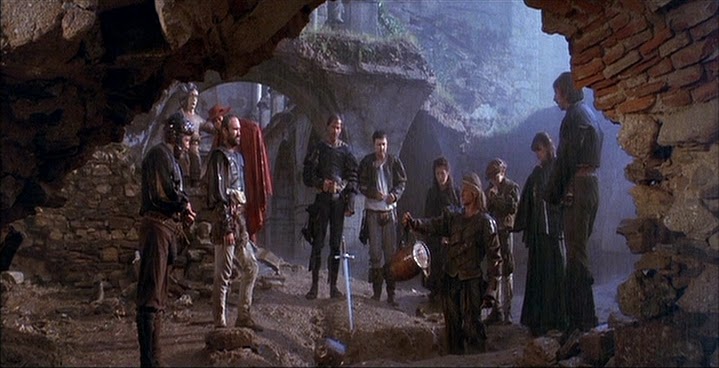
It’s an understatement to say that FLESH + BLOOD is a wildly different movie from the other medieval adventure and sword and sorcery flicks that were popular in the eighties. With its constantly shifting character relationships, symbolism and imagery, cast of characters that runs through nearly every social class, and the way that it goes completely scorched earth on that cast for its apocalyptic finale, it wouldn’t be too presumptuous to call it the closest thing we’ve gotten to Verhoeven doing a Shakespeare adaptation. Even the film’s original concept, which would have been about shipwreck survivors falling under the thrall of a religious heretic exiled to the island they crashed on, can’t help but call THE TEMPEST to mind. Whether you agree with that reading or not, you have to admit that one shouldn’t go into it expecting something along the lines of CONAN THE BARBARIAN or John Boorman’s EXCALIBUR. There is one medieval fantasy series I would say FLESH + BLOOD closely resembles, though, and that takes us back to my earlier comment about it being ahead of its time. That’s because the series in question wouldn’t be along until a decade later and wouldn’t become a household name for another fifteen years when its television adaptation hit HBO: George R.R. Martin’s A SONG OF ICE AND FIRE and A GAME OF THRONES. Sure, FLESH + BLOOD doesn’t feature much in the way of the supernatural or magic (though as Scott Ashlin elaborates on in his review, Steven might as well be a wizard) and Agnes never gets her hands on a trio of newborn dragons, which would have been a big help. What connects the two is how they enjoy knocking holes in the notion of the romanticized idea of medieval life. Much like Martin’s Westeros, Verhoeven’s 16th century Italy is a land where every authority figure is pettily corrupt, horrible bastards thrive, women have to find ways to move within what spaces a society that actively hates them allows and everything's covered in a layer or two of grime, filth and squalor. Whether or not this gritty approach is really a more realistic depiction of the Middle Ages than verdant hills dotted with shining castles and gallant knights astride white horses is a whole other discussion but there's no denying its effectiveness as a backdrop if handled correctly. FLESH + BLOOD success at doing this comes down how Verhoeven handles the difficult balancing act of never standing in judgement of its characters while at the same time making no excuses for the horrible things they do. He may be an extremely charismatic example of one but the movie never wants you to forget for a moment that Martin is a vile thug. At the same time, it's impossible not to feel sympathy for him when he has to bury his stillborn child in the only casket available, a small wine barrel, and is shocked into stunned silence when he catches sight of the infant's small hand. Its penchant for finding moments of humanity in the worst and viciousness in its best (granted, by comparison) gives the narrative much of its strength, going beyond simply saying "there are, like, no real heroes and villains, man" like that 22-year old who gets how the world works.

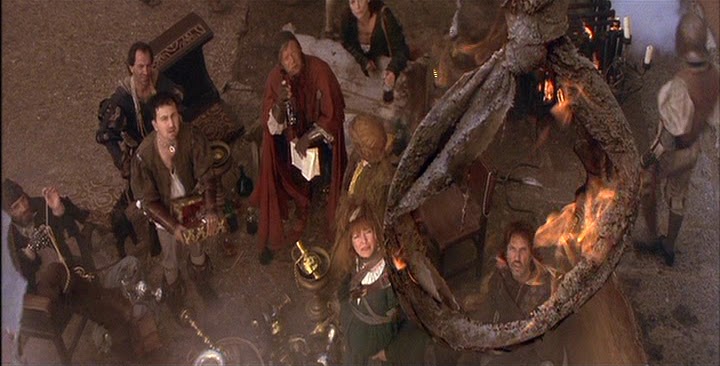
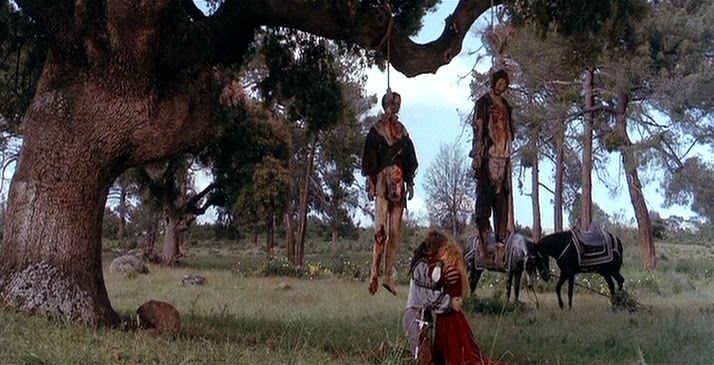
It helps that FLESH + BLOOD happens to be such a good looking movie. Cinematographer Jan de Bont, who would also work on DIE HARD and THE HUNT FOR RED OCTOBER before becoming a director himself, was a frequent collaborator with Verhoeven and between the two of them they hit on some fantastic shots and compositions of smoke shrouded battlefields, candle lit chambers, and groups of dirty face flashing wolf-like grins full of yellow teeth. It took me a while to decide on what screenshots to use with this write-up because there's so much memorable imagery in it, whether its Martin's head haloed by a burning wheel or (God, only in a Verhoeven movie) Steven and Agnes's first kiss taking place beneath a pair of hanged, rotted corpses. The film's score was composed by another Verhoeven regular, Basil Poledouris, and his orchestral themes support the visuals more than admirably, the rousing music sounding like how an exciting adventure story reads. Verhoeven hired Poledouris after hearing his score for CONAN THE BARBARIAN and would work with him again on ROBOCOP and STARSHIP TROOPERS and it's understandable why. 

Considering that there was little else like it at the time and the biggest audience for it wouldn't be along for almost two and half decades, it's not surprising that Orion Pictures had no idea how to market the film. The trailer released for it is impressively able to spoil the entire movie without telling you a single thing about it. If you were going by any of the posters used to advertise it (save for one) you wouldn't be blamed for thinking that you were in for a romantic adventure like that other medieval Rutger Hauer movie from '85, LADYHAWKE, which FLESH + BLOOD almost feels like a savage response to. Even the summary on the Netflix envelope did that. Won't lie, though, I would have liked to been in a theater to see the reaction of someone expecting a movie like LADYHAWKE and got one where its cast is pelted with chunks of plague ridden dog meat instead. ("Oh that Rutger Hauer is so dreamy, I can't wait toOH MY GOD!") Nothing says romance like The Black Death, I guess.


...

...

...

Oh, I almost forgot! 

I never told you what the other movie was. Y'know, the one that I had wanted to see on the afternoon I went to see ROBOCOP? The one that we ended up not going to because she thought it would be too scary for us kids to see. Ummm...yeah. 'bout that...


We can all agree that I came out ahead here, right?

A Little Something Extra:

Basil Poledours - "FLESH + BLOOD Suite"


But that's not all!

Grantland's Career Arc: Paul Verhoevan - A fantastic retrospective on the man's career, though I must deduct points for it leading off with a shot from ROBOCOP 3, for cryin' out loud.

On Dangerous Ground: Paul Verhoevan Interviewed: An in-depth interview with the man himself from circa TOTAL RECALL.