Showing posts with label 80's films. Show all posts

Sunday, April 24, 2016

The Gate (1987)


Directed by: Tibor Takács
Screenplay by: Michael Nankin
Starring: Stephen Dorff, Christa Denton, Louis Tripp
Running Time: 85 minutes
Tagline: "...Pray It's Not To Late."

Kids are a lot tougher than most adults will give them credit for and stuff that parents are certain will scar ‘em for life may very well end up rolling off of them like water off a duck’s back. Personal example: when I was a wee little sprout, probably not too long after my family had purchased a VHS player, we ended up renting ALIEN to watch some weekend afternoon. Memory is a little fuzzy on whether or not somebody told me that the film would be too scary for me or I came to that conclusion myself but I had elected to sit out the movie and went to play in my room. However, curiosity would eventually get the better of me and so being a stealthy little ninja, I snuck out of my room and stood at the end of the hallway, peaking around the corner at the TV screen, my family unaware of my presence.

This, coincidently, happened to be right at the time in the film where that nasty little phallus monster announced itself by exploding out of John Hurt’s chest cavity. After taking a moment for the shocked crew of the Nostromo to take in what just happened, the wormy little critter let out a weird shriek and skittered across the dining hall table, scattering glasses and dishes as it exited stage left.

I laughed, which probably startled my parents and my sisters, and sat down to join them for the rest of the movie. No nightmares at all that night about H.R. Giger’s Xenomorph, though weirdly enough I do remember having bad dreams about another movie I watched right around the same time: THE LEGEND OF BILLIE JEAN. Go figure on that one.

What does this have to do with THE GATE? Well, for starters, I was struggling with the opening for this write up for a bit and even if it ultimately fit into things a bit clumsily at the very least it worked that little writer’s block loose for me. More importantly though, my reaction to ALIEN as a kid does make me wonder how I’d have taken to THE GATE if I had caught it back then, back before I had even heard of H.P. Lovecraft*, as opposed to how dumbfounded I was when I saw it a couple of years ago via Netflix. How, I asked myself, even in the days when movies that had monsters getting exploded in the microwaves and guys getting their hearts ripped out in cultic ceremonies could be marketed as tentpole family entertainment and even R-rated gorefests like ROBOCOP and PREDATOR had action figures kids could sit on their shelves next to Transformers and G.I. Joe, had the makers of this movie managed to get away with making what amounted to a kid oriented Cthulhu mythos tale?

OK, now that I think about it, maybe this isn’t too weird. It was the eighties, after all, a lucrative time to be an effects-driven horror movie. At the same time, Spielberg and Joe Dante had made a ridiculous amount of money with a movie about a swarm of tiny monsters laying waste to suburbia. It wouldn’t be too far of a reach to suggest that some producer looked at screenwriter Michael Nankin’s script about kids being menaced by vicious little creatures and saw a chance to get some of that sweet GREMLINS cash. Heck, this is probably the only time a movie like this could have gotten made at all.

We’re introduced to the first of our three main characters, Glen (Stephen Dorff, in his first role) as he awakens from a nightmare. In it, he was trapped in his tree house as a violent storm blows up and the tree is cut down by a sudden lightning strike. You can imagine Glenn’s surprise when he wakes up the next morning and discovers that there was a storm last night that did tear that tree down. As the crew Glen’s parents hired to clean up this mess chop up the tree to be hauled off, a strange stone gets dislodged from its roots, which Glen’s heavy metal fanatic friend Terry (Louis Tripp) identifies as a geode. With thoughts of all the money they could make by selling it on their minds, Glen and Terry grab a shovel and start digging to see what else they can unearth. Their attempts pay off, even if Glenn does end up gashing his hand on a splinter from the shovel handle, with discovery of another geode, this one roughly the size of a basketball. Weird thing about that hole, though, it seems to be considerably deeper than it at first appears to be and despite repeated attempts to do so, can’t seem to stay filled in.

Glen and Terry don’t have time to dwell on that or the rather unnatural number of moths that have been gathering around his house since Glen found the stone the day before. Mom and Dad are going on a trip for the weekend and for the first time, Glen and his older sister Alexandra (Christa Denton) will not be having a babysitter. A couple of things undercut Glen’s excitement at this prospect, though. He’s grounded, for one, punishment for the burn mark one of his toy rockets left on the roof of the house, and while he and “Al” were close once, she’s reached that age where things like high school and boys take precedent over whatever little brother had planned. Once mom and dad are out of the house, Al gives in to her friends’ insistence on having them over for a party. For Glen it looks like it’s a weekend of nothing but sitting in his room and hanging out with Terry.

Then strange stuff starts to happen. First, Glen and Terry crack open that large geode, from which strange glimmers of light spill forth, and the metal shavings in one of their magnetic drawing pads arrange themselves in the shape of words and arcane symbols. Never a good idea to read strange words that just appear out of nowhere aloud, especially if you’ve have just dripped into a little blood in a strange, creepy hole, but that’s exactly what Glen does. It’s then that everything really starts to come unhinged. Glen is nearly hurt when a party levitation trick ends up working too well and after both he and Terry suffer bizarre dreams during the night, Angus, the family dog is found dead. (Whether the dog died due to natural causes or was some killed by Terry while sleepwalking isn’t clear.)

Just what is going on here? As good an explanation as any comes from an unlikely source. I mentioned that Terry is a metal head, an image he seems to be using to cope with the recent death of his mother and already distant father becoming even moreso. Well, one of his most prized possessions is a gift from his father on return from a trip to Europe, the sole album put out by British band Sacrifyx, died in a plane crash after releasing the album. Terry believes that there might be some sort of connection between what’s going on with Glen’s house and the song’s subject matter, which speaks of prehistoric evil that was banished long ago but can re-enter our world through interdimensional gateways. It’s looking more and more like that hole in Glen’s backyard is one of those rifts and they’ve cracked it open only tiny sliver; who knows what kind of nastiness will come boiling out if it’s thrown open all the way. They need a way to shut it, and while i doubt their local library has copies of The Book of Eibon and The Necronomicon stashed in the back, Sacrifyx helpfully provides one via an incantation that will close the gate if recited aloud over it backmasked into one of their songs. Unfortunately, it seems that the incantation is rendered useless if a sacrifice is sent through the gate beforehand and what Glen and Terry don’t know is that Al passed the responsibility of burying Angus to one of her friends before they all went to the that afternoon. Antsy to head out with everyone, he concluded that that hole in the backyard is as good of a place to dispose of the dog as anywhere. Hey, nothing said it had to be a human sacrifice…

Getting back to what I discussed earlier, I can see myself having had a much more visceral reaction to THE GATE than I did ALIEN as a child. While yes, big scary thing hiding in the shadows is a fear for all ages, where ALIEN really got under your skin was by clawing at things that were much more adult oriented; twisted phallic and rape imagery, and more importantly, body horror that took every bloodcurdling nightmare a woman has had about pregnancy and inflicted them on a man. No wonder that ALIEN didn’t quite get it’s hooks into me until I caught it again on cable TV during high school and had the everlovin’ bejeezus scared out of me; at age six or seven, whenever I had seen it, such things would have flown right over my head. THE GATE, by comparison, is a film all about childhood fears and anxieties, whether real, such as Glen’s anger and frustration that the big sister he’s been so close to now no longer has time for him, or imagined, like the first monster attack coming from under Glen’s bed. Those would hit much closer to home to someone my age at that time. The fact that the film is told entirely from the children’s point-of-view and there’s no adult presence for most its running time emphasizes all this.

None of that would work as well as it does if Glen, Al, and Terry weren’t believable as actual children, of course, so kudos to THE GATE to pulling that off. Dorff, Denton, and Tripp successfully sell the characters they're playing and it's nice to see, in a day when horror movies were passing off people in their twenties and even thirties as teenagers (I swear I remember one of the "teenagers" in FRIDAY THE 13TH Part 3 having gray hairs), actors cast who are the appropriate age. Credit must also go to the ways in which Nankin and director Tibor Takacs manage to communicate a very complicated personal dynamic between and personalities of the three main characters while saying very little. Moments like Alexandra, dressed in kid's pajamas, giving herself a fairly self-conscious once over in a mirror, or how Terry, dressed in denim and his wall's covered with heavy metal posters, using his rainbow colored blanket like some sort of cloak while singing along with his music. 

Of course, this is a review round-table devoted to bizarre and surprisingly hardcore kids movies, (At least it was when we started, priorities seemed to have shifted.) and now that I've established what makes this a movie for children, allow me to now go into what makes it so unsual. The film has an appropriate title because, despite the suburban California setting and protagonist's age, it really does feel like an unofficial entry into one of Lucio Fulci's "Gates of Hell" movies. When THE GATE gets down to business it has no problem going for the same kind of surreal, doesn't-give-a-damn-if-it-makes-sense-or-not nightmare logic that marked that trilogy of films. You might even be reminded of THE BEYOND's cranky undead sorceror when the reality warping powers of this particular hellmouth makes Terry's ghost-story about a dead worker walled up in Glen's house come unpleasantly true. Jesus Christ, in fine Fulci fashion, THE GATE even contains multiple examples of horrific eye trauma! THE GATE ends up being such a perfect little primer for the kind of batshit insanity and repulsion that you can find in Italian horror films, I'm honestly amazed that nobody from Italian film industry was involved in making it!

I imagine a good bit of this is what's leftover from what writer Nankin originally intended the film to be. He had written the script at a low point in his career following the collapse of a film project and, drawing on what he called "the nastier impulses from childhood," had envisioned it as a hard-R horror film starring even younger protagonists. Obviously that wouldn't fly at all, so when the project was picked up it was refashioned into a more family-oriented PG-13 movie with some year's added to the protagonist's age. However, these changes I think may be a major cause for what ends up being one of THE GATE'S big missteps: the monsters themselves.

THE GATE, as a stated, is a horror film cut from the same cloth as H.P. Lovecraft, where mankind is constantly threatened from reality warping alien gods and their spawn. When it came to visualizing his creatures, though, Lovecraft had the benefit of being a prose writer, and so therefore he all needed to do is provide a few vague hints at whatever squidgy tentacled terror from beyond currently threatening his neurotic protagonists looked like with a few greater implications hanging on the fringes of the narratives and his audiences imagination could do the heavy lifting for him. Movies have had a much more difficult time selling whatever eldritch creatures they create as an apocalyptic terror. Just being able to see the thing undercuts some of that, after all. And the problem with THE GATE is that it never quite successfully sells its creatures as the world ending threat that it wants you to believe they are. These things seem to have a difficult time bringing down three kids no matter what form they take and the chief demon that appears in the final act, impressive looking as it is, doesn't seem to do that much. Which is disappointing because the techniques used to create these creatures are absolutely fantastic. The aforementioned boss demon is an amazingly well done piece of Harryhausen-esque stop motion animation and its imp-like minions are realized through a combination of men-in-suits and some of the most seamless forced perspective cinematography I've seen. It's no surprise that the film's FX supervisor would go on to work on Peter Jackson's LORD OF THE RINGS films.

THE GATE had a successful run at the box office but really took off once it hit home video and cable, which convinced the studio to green light at sequel, though behind-the-scenes troubles kept THE GATE II: TRESPASSERS from being released for nearly two years. The film is considerably different from the first and involved a teen aged Terry (Louis Tripp again) summoning up and binding one of the little imp creatures so that he can use its wish granting abilities to help his alcoholic dad. There's some interesting things going on in the sequel; Terry's increased interest in the occult is a logical enough step for the character, the finale features yet another impressive stop motion monster and the film takes some stabs at dealing with a home broken by the loss of a loved one in the same way the first dealt with childhood anxieties. However, it never quite comes together and later developments in the movie feel like the filmmaker's couldn't quite decide what they wanted the sequel to be about. There was talk of a remake not to long ago, directed by Bill S. Preston, Esq. himself, Alex Winter, that used Nankin's original screenplay and creature designs by ALIEN's H.R. Giger but nothing ever came of it and Giger's recent passing probably means nothing ever will. Oh well, what could have been.


This review is part of the "You Know, For The Kids" round table hosted by the Celluloid Zeroes blogging cabal, dedicated to both the weirdest movies aimed at kids and movies that serve as gateway drugs for future cinema junkies. If you're itching for more, click on the links: THE MAGIC SERPENT at Micro-Brew Reviews, THE 5,000 FINGERS OF DR. T over at Web Of The Big Damn Spider, TIME BANDITS at Checkpoint Telstar, GAMERA Vs. VIRAS at The Terrible Claw Reviews, and SPIDER-MAN at Seeker of Schlock. 

A Little Something Extra:
Obviously, I couldn't write up a review about a movie where heavy metal music plays such a big role with out throwing in something at the end? So here's arguable one of the most metal tunes of all time: "Number of the Beast" by Iron Maiden.


Sunday, September 13, 2015

Miracle Mile (1989)


Y'know, considering MIRACLE MILE's subject matter, whoever decided on "A Welcome Blast!" for the pull quote there needs to be sat down and given a good talking-to. 

Director: Steven de Jarnatt
Screenplay by: Steven de Jarnatt
Starring: Anthony Edwards, Mare Winningham, John Agar, Lou Hancock, Robert DoQui, Denise Crosby, Mykelti Williamson, Kurt Fuller, Brian Thompson, Earl Boen
Running Time: 88 minutes
Tagline: "There are 70 minutes to the end of the world. Where do you hide?"

You won’t realize it the first time you watch it, but MIRACLE MILE’s opening is a fantastic piece of misdirection. It introduces us to geeky jazz musician Harry Washello overlooking the city of Los Angeles as he’s playing his trombone and gazing longingly at a picture of his newfound love, Julie Peters. Harry’s narration establishes that this scene is taking place in media res and we’re settling in for his recounting of how he and Julie first met and the whirlwind romance that follows. Going by the rules of your standard cinematic romance, we’d eventually circle around to that opening moment again somewhere between the tearful break up and whatever crazy stunt Harry is going to pull to win Julie back. However, MIRACLE MILE, as it turns out, is most definitely not your standard movie and more importantly, we never return to that opening scene at any point. It leaves you wondering whether or not that happened or if it’s the film asking “What could have been?” Is this where things would have gone if they had played out as expected and Harry and Julie’s lives not been completely disrupted? Who knows? But it makes it clear that MIRACLE MILE loves to mess with you, leading you in one direction before gleefully sending you hurtling down another.

Pausing to note how eerily prophetic the backdrop for it is going to ultimately be, we see Harry (Anthony Edwards) and Julie (Mare Winningham) have their regulation meet cute during a tour of the La Brea Tar Pits’ George C. Page museum. Harry admits he’s never been one to have much luck with the ladies so you can imagine his elation at how well he’s hitting it off with her. The two end up spending the whole day together; attending a charity concert that Harry’s playing at, buying lobsters from a restaurant and releasing them back into the ocean (“FREEDOM! HORRIBLE FREEDOM!”), rides on the carousel; the usual quirky boy-meets-girl montage. Only an awkward encounter with Julie’s estranged grandparents (John Agar and Lou Hancock) puts a bit of a damper on the good mood but doesn’t stop Harry and Julie from making plans to go dancing later that night, right after Julie’s finished her shift at the diner where she works. Unfortunately, a freak accident knocks out the power in Harry’s building, meaning his alarm doesn’t go off when it’s supposed to and by the time he makes it to the diner, a heartbroken Julie is long gone. Desperate to explain himself and make things up with her, Harry calls her on the pay phone outside the diner but only gets her answering machine. Before Harry can head back into the diner for an early breakfast, the phone rings again and he jumps on it, hoping that it’s Julie.

It ain’t Julie and this is where MIRACLE MILE really shifts gears and gives us the biggest tonal swerve in a movie this side of DUCK YOU SUCKER and FROM DUSK ‘TIL DAWN.  The panicked voice on the other end belongs to a soldier stationed at a missile silo somewhere in North Dakota who dialed the wrong number trying to get in touch with his father in Orange County. From what Harry can decipher of his frantic ravings, something’s gone wrong and the warheads have been launched. In fifty minutes, they’re going to hit Russia and in an hour and ten minutes, the U.S.S.R’s retaliatory strike will hit L.A. At first, Harry is convinced that he’s the victim of a random prank caller, but when he hears the sound of gunfire and a sinister voice tells him to ignore everything he’s heard and to go back to sleep, he realizes this may be the real thing after all. World War III could very well be on its way and convincing anyone of this and more importantly, getting to Julie so the two of them can get the hell out of Dodge, becomes Harry's number one priority. From here, MIRACLE MILE switches over to real-time for its last hour and ten minutes and takes on a hazy, fever dream-like feel, as though we've become trapped in Harry's rapidly escalating nightmare. The film will play its cards close to its chest, leaving you wondering for much of its running time whether the phone call is real or if Harry, in his own words, is being another Chicken Little, kicking over dominoes and causing chaos in the lives of those he comes across. When we finally do get a concrete yes or no answer to what is going on...well, you'll have to see for yourself.

The switch over from a sunny romantic jaunt to paranoid end-of-the-world thriller is a difficult trick to pull off, so credit to writer / director Steven De Jarnatt for doing so without a solitary hitch. He penned the script for MIRACLE MILE in 1978 but despite the positive response to it, his refusal to change the ending meant he couldn't get it produced for nearly ten years. (At one point it was going to be a segment of the TWILIGHT ZONE movie.) This delay may actually have worked out in MIRACLE MILE'S favor, however. The film's 1989 release date, right in the ending stretch of the Cold War, makes MIRACLE MILE feel like an exclamation point, a final word on the past decade. Here's everything we were in the eighties; here's how bloody terrified we were that it was all going to be gone in an instant, swept up in a nuclear fireball courtesy of the U.S.S.R. Though the two film's are wildly different in terms of tone and approach to storytelling, I can't help but be reminded of John Sayles' THE BROTHER FROM ANOTHER PLANET. Both are snapshots of an incarnation of a major city that no longer exist; pastel-and-neon Los Angeles for MILE; seedy, graffiti covered New York for BROTHER; their protagonists' odysseys cross-sections of the lives and experiences of the different people who inhabited them. I would have loved to have visited these places; wandered their streets just to see what I could see. Money, distance and the passage of years have made that hard if not outright impossible, so I'm much obliged when I can find a movie that captures a place and time so vividly you feel like you could crawl in the screen and live there.

(Keeping with the whole "snapshot" idea, I enjoy how the film's cast features a plethora of recognizable faces from eighties pop culture. Not only Anthony Edwards, who was coming off the success of REVENGE OF THE NERDS and TOP GUN, and Mare Winningham, queen of eighties TV movies, but keep an eye on the rest. You'll spot the chief from ROBOCOP (Robert DoQui), Henrietta from EVIL DEAD 2 (Lou Hancock), Tasha Yar (Denise Crosby), one of the Sorels from STREETS OF FIRE (Mykelti Williamson), Vasquez from ALIENS (Jenette Goldstein) and Dr. Silberman from THE TERMINATOR. (Earl Boen) Even the Night Slasher himself  (Brian Thompson) puts in an appearance.)

As much as it is as love letter to Los Angeles, MIRACLE MILE a movie about fate, that it doesn't matter that you just met this great girl or had this child or got this promotion; things are going to happen that are going to be out of your control. It's an idea we don't like to think on that much, because it's just so big. That's what makes MIRACLE MILE so damned effective. By keeping its stakes on a smaller, more personal scale; get the girl, get out of the city; and leaving its threat off-stage for much of its running time so it can focus on them, it succeeds better at selling you on what's at risk and really digging into the whys and hows of people's reactions to knowing what's coming for them. This wouldn't have been possible if it started dropping real estate on everybody's heads from the word go. How Harry reacts is one of the things that makes the film so interesting, Going back to my earlier statement about MIRACLE MILE loving to play with your expectations, take a look at him. He's this wholesome, nice fellow, the straight white guy out to rescue the woman he loves. By the way popular culture has coded us to think, he should be the hero, right? Matter of fact, Harry is one of the film's most self-centered characters, willing to lie, manipulate and even coerce others if it can get them to work for his benefit. He even does this to Julie, deliberately keeping her in the dark about what's going on until he can get her to safety. We still root for him, poor sap's just in over his head, after all. It's when you compare Harry's behavior to the other characters that it become even more significant. Who keeps calm and organizes an evacuation? A woman. The one person who is running around L.A. trying to rescue someone for selfless reasons? A black man, a minor character who returns for a truly tragic send off. Hell, the most heroic character in MIRACLE MILE is a gay helicopter pilot. Considering how often characters like this were depicted as sidekicks, jokes, crazies and cannon fodder in eighties movies, (and today, really) it's unique to find a movie that sympathizes so much with the misfits and outliers.

In the original screenplay, the main characters of MIRACLE MILE were intended to be an older couple. Subsequent drafts moved them into supporting roles, that of Julie's grandparents. It's fitting then, that they quickly realize what it takes Harry the whole movie to understand: you can't run from the inevitable. Sometimes all you can do is find something worth holding onto as you wait for what's coming. The conclusion is an incredibly emotional one and difficult to pin down; definitely not a happy one but I wouldn't call it hopeless either. A lot of apocalyptic fiction doesn't understand that there needs to be slivers of light amidst all the horror or you're just being a depressing slog. MIRACLE MILE understands this and that is what gives its ending its punch, which is not lessened one bit by repeat viewings. I watched the film multiple times in preparation for this, and damned if I didn't need to compose myself when the credits rolled every single time.

A Little Something Extra:

Tangerine Dream - "Teetering Scales." Continuing with the whole "80's in summation" theme, MIRACLE MILE features a great, gloomy synth score by Tangerine Dream, who supplied the soundtrack for several notable genre films from that decade.


Want to know what some friends of Psychoplasmics thought of MIRACLE MILE? Tim Lehnerer tackles it over at Checkpoint-Telstar and Jessica Ritchey talks about what it means to her personally over at RogerEbert.com.


Sunday, September 6, 2015

Flesh + Blood (1985)


Director: Paul Verhoevan
Screenplay by: Gerard Soeteman and Paul Verhoeven
Starring: Rutger Hauer, Jennifer Jason Leigh, Tom Burlinson, Susan Tyrrell, Brion James, Ronald Lacey, Jack Thompson
Running Time: 2 hours and 8 minutes. (Unrated Edition)
Tagline: “Betrayed by power. Corrupted by love. Bound by honor.”

Hop in the Way-Back Machine and set the dial for the summer of 1987. Little Bill Smiley is living with his parents and two older sisters in Union Grove, a wide place in road somewhere in the hills of rural Alabama. He loves watching movies, has ever since his family took him to see a re-release of STAR WARS in theaters, and right then there was one movie that he wanted to see more than anything. You can imagine how happy he was when his mom informed him that a friend of the family, her name forgotten thanks my increasingly fuzzy memory, was going to be taking her son and couple of his friends to the movie theater over in Huntsville and asked if he would like join them. No question what his answer was. Once he was in the car and couldn’t back out, though, he was given some disappointing news. See, she was concerned that the movie he wanted to see may have been “too scary” for her kids to watch and wondered if he was open to the idea of seeing a different movie. This was a big let down for Little Bill, he really wanted to see that other movie, but the one they suggested sounded cool. Something about a robot cop.

It’s a shame that I don’t remember who that woman was and neither would anybody else who’s still around for me to ask. Even if, I doubt that she would remember that day anyhow because that’s close to thirty years now. Good God. But I’m still curious to know that if at any moment sitting in that Hunstville theater, watching ROBOCOP, she ever considered that maybe we should have gone to that other movie I wanted to see. ROBOCOP was not, as we assumed, some safe action adventure full of wacky hijinks to please the popcorn crowd and little else. The violence was bigger and messier than everything else, the level of excess wasn’t so much turned all the way up as it was somebody tore the dial off, and the humor was of the pitch black variety. Within fifteen minutes, we witness our hero getting tortured and cut to pieces with shotguns. Corporate executives talk about an accident that resulted in a horrific death more in terms of what it would mean to them financially rather than show concern for the schmuck that got turned into paste. A rapist takes a bullet in a very uncomfortable but deserving place, an executive is snorting coke out of a model’s cleavage before he’s executed by his rival’s henchman, and one goon ends up doing an extremely unhealthy impersonation of the Toxic Avenger. She must have been horrified, or maybe she wasn’t, since we stayed through the whole movie. We’ll never know. I can tell you what I thought of it and what the other kids thought of it, we thought it was the greatest thing we had ever seen. It warped my fragile little brain in the best possible way. Naturally, when my sister Susan wanted to go to the mall a couple weeks later, you can guess who convinced her to take him along and what movie he wanted her to take him to see. I wish could say this was the story of how ROBOCOP is the only movie I’ve seen more than once in the theater but that would be a lie. I really don’t like to advertise that I also saw CROCODILE DUNDEE II twice, you understand.

Such went my introduction to director Paul Verhoeven, seen here being his usual restrained self on the set of ROBOCOP:


If you want my opinion, it’s a crime that we’re no longer getting a new movie from Verhoeven every two or three years. Like John Milius before him, he was a filmmaker who managed to find mainstream success making movies that grabbed their audience by the throat and didn’t give a flying damn whether or not their precious sensibilities got offended in the process. Back then, discovering a film like that was like taking a big hit of the strong stuff when all you’ve ever had was flat soda, and even today, with too much of our popular genre entertainment made up of PG-13 no-risk safe bets, revisiting Verhoeven’s filmography feels particularly revelatory. Come to think of it, it’s a crime that Milius isn’t making movies any more too or, though he had a major hand in DEADWOOD, my favorite TV show, the only thing of Walter Hill’s that’s made into cinemas in the past decade and change was the simply adequate buddy actioneer BULLET IN THE HEAD. That could have been directed by anybody, climatic STREETS OF FIRE-style axe duel between John Rambo and Khal Drago aside. When these men stopped making movies or were forced to find work elsewhere, testosterone cinema got a good deal less interesting, now mostly a home for aging action stars to show that grandpa can still hang with the cool kids. Said he, with a knowing nod to the copies of THE EXPENDABLES 1 & 2 he owns on blu-ray. Yes, I’m eyeing the Unrated edition of the third one too. Anywho, back on topic…


A disposition for splashing more blood around and showing off more bare breasts than the other guys is appreciated but that’s not all that Verhoeven has going for him. I may not have been able to put into words why, but even back then, I kept wanting to return to ROBOCOP and his other efforts for reasons that went beyond just tickling my reptile brain. A movie doesn’t leave the impression on somebody that this one did me if all it’s going for is simply being edgier-than-thou. There’s the funhouse mirror effect the movie has, highlighting the insane bullshit of the nineteen eighties and American culture by distorting the hell out of it. Like I said in my review of COBRA, Robocop is the Reagan-era action hero taken to its most logical extreme: an actual killing machine programmed to spout inane catchphrases while blowing people away. Tip of the ice berg. The film is interrupted by news breaks where anchors with fake smiles cheerfully report that dozens of people died when a satellite laser malfunctioned or commercials where families bond over a Battleship-clone based around thermonuclear war. Criminals discuss their drug empire using the same jargon that the corporate executives do. Violence that’s horrific when inflicted on the hero becomes triumphant when aimed at more deserving targets. Verhoeven makes it clear that he’s in on the joke and it carries over to his other movies as well. Of course, TOTAL RECALL’s Doug Quaid is really an invincible secret agent who can wipe out small armies single-handedly, he’s played by Arnold Schwarzenegger! STARSHIP TROOPER’s cast being made up of so many bland pretty people is a feature, not a bug, no pun intended. I haven’t seen SHOWGIRLS but I have seen BASIC INSTINCT and just going by the latter I could tell both were made with the understanding that the best way to goof on Joe Ezsterhas’s coked up screenplays is to let them speak for themselves. It’s not just satire and excess though. For big budget blockbusters, they can be strangely personal movies. Verhoeven grew up in the shadow of WWII in the Nazi-occupied Netherlands and what he experienced there informs not only STARSHIP TROOPERS'S farcical spin on facism but his whole filmography. When Verhoeven discusses how a religious experience left him doubting his sanity and he took up filmmaking to keep himself grounded, TOTAL RECALL suddenly looks like a bit of wish fulfillment, a man solving his own upset mental state via simple brute force. Underneath all the blood, guts, feathers and eyeballs flying everywhere, ROBOCOP’s story is tragically humane. A family man has his life and soul stripped from him, rebuilt as a walking coffin with a knight-in-shining-armor exterior, all so some yuppie can stick it to his business rival and get a cushier office. What follows is his fight to get something of that back and I never fail to do a little fist pump when, at the end, a smile crosses Peter Weller’s face as he answers “What’s your name?” with “Murphy.” That the moment is punctuated by Basil Poledouris’s fantastic score immediately kicking in helps.


But I’m not actually here to talk about any of those movies. The last couple of pages you just read there was an introduction that grew in the telling. See, Verhoeven made several films before he hit it big, most in his native homeland which can be frustratingly hard to get one’s hands on over on this side of the pond. He did make one English-language movie before ROBOCOP and I think it deserves a good bit more attention than it’s received. Like everything the man does, it’s an unusual and unique movie that as it turns out, was even a little ahead of its time. From 1985, Verhoeven’s medieval action-drama FLESH + BLOOD.


The year is 1501 and we’re somewhere in Italy, dropped in the middle of the siege of some nameless city by the forces of nobleman Arnolfini. (Fernando Hulbrek) See, Arnolfini used to rule over this city and I think it can be deduced by the good sized army of soldiers and mercenaries he’s brought with him, he’s somewhat displeased with his being ousted from it. Capture the city before the end of the day, he informs the troops, and you’ll get free reign over it for the next twenty four hours. Goes without saying that the offer of a full day of unrestrained looting and pillaging is all it takes to motivate Arnolfini’s forces, lead by Hawkwood (Jack Thompson) and the ruthless Martin (Rutger Hauer), to finally break the siege and begin the attack proper. One other person of note we’re introduced to here is Arnolfini’s son, Steven (Tom Burlinson), an engineering genius in the DaVinci mold, who is taking part to show off some of the siege weaponry he’s invented. (There are still a few minor problems he hasn’t worked out yet, as that sap who volunteers to test his mobile bomb finds out the hard way.)

Arnolfini soon comes to regret his offer when he sees the alacrity with which the mercenaries take to their sacking of the city. There’s a good chance that there won’t be much of the place left before the day’s even half over and he’s not about to let some sellsword rabble tear apart what he worked so hard to reclaim. When he learns that during the battle that Hawkwood injured a young nun and the old soldier is willing to do anything to help the girl, he seizes the opportunity. Using the girl as leverage, Arnolfini convinces Hawkwood to turn on his former comrades. Forced to surrender, Martin and his mercenaries are stripped of their weapons and loot and then driven out of the city. When we rejoin them later, their numbers have dwindled down to only a handful of thugs and camp followers. When Selene, a prostitute who is pregnant with Martin’s child, gives birth, the child ends up dying. While digging a grave for the baby, they discover a statue of St. Martin of Tours, the patron saint that Martin himself was named offer. One of Martin’s men, a loony nameless Cardinal (Ronald Lacey, the creepy Peter Lorre-esque Nazi from RAIDERS OF THE LOST ARK) takes this as a sign from God that Martin is a chosen one who will lead them to glory. Now, one gets the impression that Martin doesn’t completely buy into this but the man is itching for revenge against Arnolfini and Hawkwood and as history has proven over and over, saying God is on your side with enough conviction gets people to rally behind your cause.

There’s still one more important character that needs to be introduced and she makes her way into the narrative right about now. Agnes (Jennifer Jason Leigh) is the daughter of a local prince and Arnolfini has arranged for her to be Steven’s wife. The young scientist scoffs at the idea, too interested in his studies and inventions to want to settle into the married life just yet; his father has to trick him into coming along on a “hunt” to get the boy to even meet up with her. Once the two do manage a few moments alone, however, Agnes wins him over. It’s during her seduction of Steven that we pick up that Agnes possesses a good degree of cunning and knows how to play people to her advantage. This skill is going to come in handy because things are about to go south real fast. On their way back to Arnolfini’s castle, they’re ambushed by Martin and his cohorts disguised as pilgrims. Arnolfini gets laid out with a spear wound to the chest and Agnes is unable to escape from the wagons before Martin’s crew steals them. Later that night, as the mercenaries are reveling in their victory and enjoying their newly acquired spoils, they stumble across Agnes in her hiding place and despite her attempts at bargaining with them, she ends up thrown to the wolves. Agnes is quick to notice that Martin doesn’t seem quite so keen on sharing her with the rest and it’s while Martin is raping her that she decides to start acting as though she enjoys it. Horrifying and hard to watch as this scene is, her gambit works and as one of his men makes a move towards her Martin starts a fire as a distraction.

When the fire results in the St. Martin statue they’ve been dragging around with them shifting around, Martin tells everyone this is another sign pointing towards their future fortunes and has them move out. When they pass by a castle the next day, Martin decides this is as good of a place to as any to set up shop. He has Agnes accompany him when he breaks into the place so he can open the gates and let the rest in to kill the occupants; they waste no time in making themselves the lords of their new little domain. Tensions are already building, though, as it becomes apparent that whatever new fangled rules the mercenaries have sworn to live by, Martin certainly doesn’t think they apply to him or his new playmate. The party gets cut short anyway because the daughter of the castle’s lord, a sickly young girl, was able to escape the attack and was found by Steven. Before she expired, her raves about “devils” breaking into her home are enough to clue Steven in that he’s headed in the fight direction. He’s brought some help too: a few dozen of his father’s soldiers and Hawkwood, who he’s extorted into helping him. Unfortunately, that girl they found was infected with the bubonic plague; now Hawkwood has caught it and the bloodletting used to treat him doesn’t seem to be doing more than hastening along his demise. With him out of action, it’s up to Steven, using both his engineering acumen and a willingness to be every bit the ruthless bastard his father is, to find a way to get into this castle and Agnes out. Yes, ladies and gentlemen, we’re in Robert E. Howard’s favorite hang out: Barbarism vs. Civilization, and Agnes, caught in between the two, is going to do whatever she can to make sure she’s still alive when the smoke clears.

It’s impressive that FLESH + BLOOD comes together as well as it does because by all accounts, it was an absolute nightmare to shoot. The America-Dutch co-production was Verhoeven’s first English language film and he was still learning to speak it while filming, which often made communication with its multi-national cast difficult. While the film’s six million dollar budget was larger than anything Verhoeven had to work with back in the Netherlands, it didn’t quite match the ambitions of this project and you can tell things were getting stretched a little thin by the time the finale rolls around. Disputes over the portrayal of Martin ultimately lead to Verhoeven’s refusing to ever work again with Hauer, who had been his lead actor of choice back in the home country. Most notably, is that due to studio interference, the movie we ended up with wasn’t the movie that Verhoeven had set out to make. What he was originally going for was something akin to THE WILD BUNCH with swords; Martin as Pike Bishop and Hawkwood as Deke Thorton, respectively. The studio, on the other hand, wanted the focus to be more on the supposed love triangle between Martin, Agnes, and Steven, so Hawkwood ended up being relegated to a supporting role. Well, as much as I hate to side with the bean counters over an artist, this worked out in the film’s advantage. Of the two stories, that’s simply the more compelling one and it all due to the character of Agnes. Women who will do whatever they can to survive, even if it means crawling over a dead body or two, are a staple of Verhoeven’s films and she’s without a doubt one of the best examples. She’s smart enough to realize that Martin claiming her as his woman is the only way to ensure any degree of safety and is willing endure his brutal attentions if it means staying out of the hands of the others. What surprises her is that, as the movie goes on, her medieval Patty Hearst act gets her in touch with a more devilish side of herself and danged if she doesn’t find something a little liberating about being the queen of this bunch of lunatics. Of course, once Steven and company come knocking, that’s not going to slow her down one iota in letting him know that he needs to hurry up and get her out of there.

It’s an understatement to say that FLESH + BLOOD is a wildly different movie from the other medieval adventure and sword and sorcery flicks that were popular in the eighties. With its constantly shifting character relationships, symbolism and imagery, cast of characters that runs through nearly every social class, and the way that it goes completely scorched earth on that cast for its apocalyptic finale, it wouldn’t be too presumptuous to call it the closest thing we’ve gotten to Verhoeven doing a Shakespeare adaptation. Even the film’s original concept, which would have been about shipwreck survivors falling under the thrall of a religious heretic exiled to the island they crashed on, can’t help but call THE TEMPEST to mind. Whether you agree with that reading or not, you have to admit that one shouldn’t go into it expecting something along the lines of CONAN THE BARBARIAN or John Boorman’s EXCALIBUR. There is one medieval fantasy series I would say FLESH + BLOOD closely resembles, though, and that takes us back to my earlier comment about it being ahead of its time. That’s because the series in question wouldn’t be along until a decade later and wouldn’t become a household name for another fifteen years when its television adaptation hit HBO: George R.R. Martin’s A SONG OF ICE AND FIRE and A GAME OF THRONES. Sure, FLESH + BLOOD doesn’t feature much in the way of the supernatural or magic (though as Scott Ashlin elaborates on in his review, Steven might as well be a wizard) and Agnes never gets her hands on a trio of newborn dragons, which would have been a big help. What connects the two is how they enjoy knocking holes in the notion of the romanticized idea of medieval life. Much like Martin’s Westeros, Verhoeven’s 16th century Italy is a land where every authority figure is pettily corrupt, horrible bastards thrive, women have to find ways to move within what spaces a society that actively hates them allows and everything's covered in a layer or two of grime, filth and squalor. Whether or not this gritty approach is really a more realistic depiction of the Middle Ages than verdant hills dotted with shining castles and gallant knights astride white horses is a whole other discussion but there's no denying its effectiveness as a backdrop if handled correctly. FLESH + BLOOD success at doing this comes down how Verhoeven handles the difficult balancing act of never standing in judgement of its characters while at the same time making no excuses for the horrible things they do. He may be an extremely charismatic example of one but the movie never wants you to forget for a moment that Martin is a vile thug. At the same time, it's impossible not to feel sympathy for him when he has to bury his stillborn child in the only casket available, a small wine barrel, and is shocked into stunned silence when he catches sight of the infant's small hand. Its penchant for finding moments of humanity in the worst and viciousness in its best (granted, by comparison) gives the narrative much of its strength, going beyond simply saying "there are, like, no real heroes and villains, man" like that 22-year old who gets how the world works.

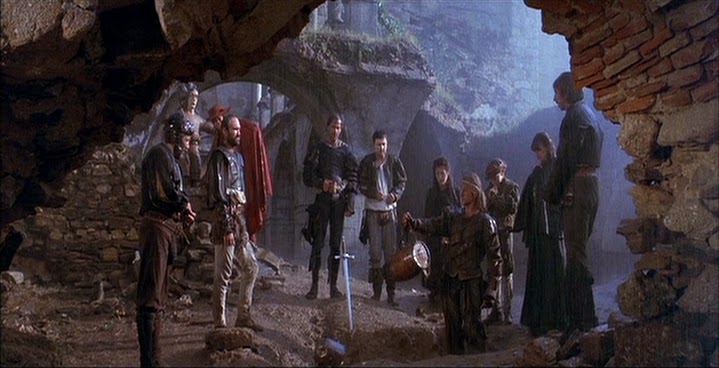
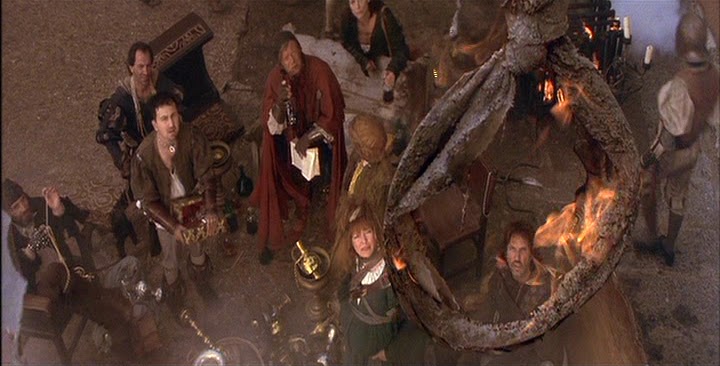
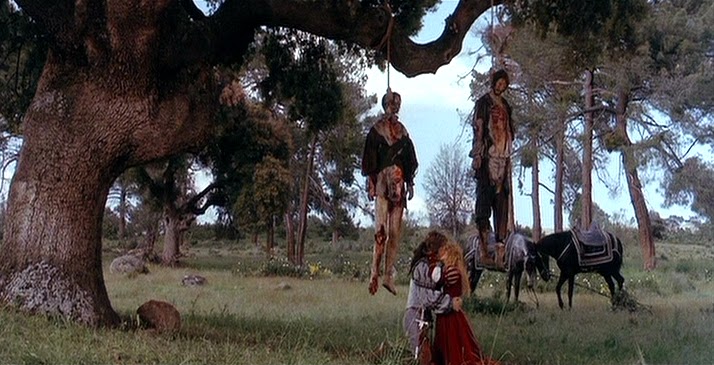
It helps that FLESH + BLOOD happens to be such a good looking movie. Cinematographer Jan de Bont, who would also work on DIE HARD and THE HUNT FOR RED OCTOBER before becoming a director himself, was a frequent collaborator with Verhoeven and between the two of them they hit on some fantastic shots and compositions of smoke shrouded battlefields, candle lit chambers, and groups of dirty face flashing wolf-like grins full of yellow teeth. It took me a while to decide on what screenshots to use with this write-up because there's so much memorable imagery in it, whether its Martin's head haloed by a burning wheel or (God, only in a Verhoeven movie) Steven and Agnes's first kiss taking place beneath a pair of hanged, rotted corpses. The film's score was composed by another Verhoeven regular, Basil Poledouris, and his orchestral themes support the visuals more than admirably, the rousing music sounding like how an exciting adventure story reads. Verhoeven hired Poledouris after hearing his score for CONAN THE BARBARIAN and would work with him again on ROBOCOP and STARSHIP TROOPERS and it's understandable why. 

Considering that there was little else like it at the time and the biggest audience for it wouldn't be along for almost two and half decades, it's not surprising that Orion Pictures had no idea how to market the film. The trailer released for it is impressively able to spoil the entire movie without telling you a single thing about it. If you were going by any of the posters used to advertise it (save for one) you wouldn't be blamed for thinking that you were in for a romantic adventure like that other medieval Rutger Hauer movie from '85, LADYHAWKE, which FLESH + BLOOD almost feels like a savage response to. Even the summary on the Netflix envelope did that. Won't lie, though, I would have liked to been in a theater to see the reaction of someone expecting a movie like LADYHAWKE and got one where its cast is pelted with chunks of plague ridden dog meat instead. ("Oh that Rutger Hauer is so dreamy, I can't wait toOH MY GOD!") Nothing says romance like The Black Death, I guess.


...

...

...

Oh, I almost forgot! 

I never told you what the other movie was. Y'know, the one that I had wanted to see on the afternoon I went to see ROBOCOP? The one that we ended up not going to because she thought it would be too scary for us kids to see. Ummm...yeah. 'bout that...


We can all agree that I came out ahead here, right?

A Little Something Extra:

Basil Poledours - "FLESH + BLOOD Suite"


But that's not all!

Grantland's Career Arc: Paul Verhoevan - A fantastic retrospective on the man's career, though I must deduct points for it leading off with a shot from ROBOCOP 3, for cryin' out loud.

On Dangerous Ground: Paul Verhoevan Interviewed: An in-depth interview with the man himself from circa TOTAL RECALL.


Monday, August 31, 2015

Wes Craven 1939 - 2015


A NIGHTMARE ON ELM STREET could have been the only movie Wes Craven ever made and it would have been enough. Age, the numerous sequels and imitators, Freddy Krueger’s transformation into a pop culture icon have done nothing to diminish how original and legitimately terrifying the first movie was. From the opening moments, as we watch Krueger assembling his signature glove, we feel like we’re trapped. We’re in that boiler room with him, curled up in a corner, and he’s about to use that thing on us. It never lets up from there, dragging us into this dark fantasy about parents’ sins coming back around on their children in the worst way. Before he was reshaped into a wisecracking cartoon character, Krueger was the boogeyman through and through. When he corners his first victim in the original movie and she begs God for help, there are no wisecracks, no gimmicks. He just brandishes that damn glove at her and with a gleefully sadistic smile on his face, snarls “THIS is God!” For years afterward, late at night, as I’m lying in bed, trying to get to sleep, my subconscious would love to occasionally poke me with that moment. It’s only fitting.


Funny thing is, I didn’t get around to seeing to seeing the first NIGHTMARE until I was in college, renting it from Video Warehouse, one of those mom and pop places that don’t exist anymore. Y’know, where you could walk in with ten dollars and walk out with a big stack of VHS cassettes and still have enough left over to go grab a burger and a soda. My first NIGHTMARE movie was the third one, THE DREAM WARRIORS, which one of my sisters rented back when I was a sprout. Craven didn’t direct that one but he was involved as a producer and wrote the story, hoping to right the ship after New Line Cinema rushed out a cheap sequel, the amazingly inept FREDDY’S REVENGE. Even before that, though, little Bill Smiley knew who the hell Freddy Krueger was. If you did any growing up in the mid-to-late 80’s, you couldn’t escape him. He was at the theater, he was on TV, magazines, comics, he was showing up in commercials. To me and other like kids me, the man with hat and glove and certain hockey-mask wearing hulk were our Dracula and the Wolf Man. Our Godzilla and King Kong. They were the guys in those movies that your parents and the Helen Lovejoys of the world didn’t want you to see, which just made you more determined to get your hands on them. ALIEN may have been my first horror movie but it was the NIGHTMARE series that made me sit up and take notice of the genre.

 Had NIGHTMARE been it, that would have been enough and Craven’s death yesterday from cancer would have hit fans of horror films every bit as hard. Thing is, Craven did more than give the world Freddy Krueger. I don’t know if I could unequivocally say that he had the most impact on the horror genre when compared to his contemporaries. That would have to be settled via a fight with John Carpenter while George Romero referees, but nobody did it in the way that Craven did. Most directors would give their good teeth to make a movie that had an impact on popular culture that something like HALLOWEEN or THE EXORCIST did. With LAST HOUSE ON THE LEFT, NIGHTMARE, and SCREAM, Craven did that three times across as many decades. Dig deeper than that and you’ll see how ahead of his time his output could be. The only NIGHTMARE sequel he directed, THE NEW NIGHTMARE, was doing meta-fictional horror years before every Inky, Blinky, and Clyde in the film industry was having their characters go “Wow, this totally like a horror movie!” THE PEOPLE UNDER THE STAIRS had an African-American kid and a young girl as its heroes back when that was something that didn’t happen. Heck, Craven was pretty big on giving memorable roles to women in his movies. Apologies to HALLOWEEN’S Laurie Strode, NIGHTMARE’S Nancy Thompson is the Ur Final Girl of slasher movies as far as I’m concerned, an ancestor of characters like Buffy Summers. Not surprising that the best NIGHTMARE movies not only have Craven’s heavy involvement but have Heather Langenkamp in the cast, too. (We at Psychoplasmics are all LANGENKAMP UBER ALLES up in here.)


Significant thing about this is that Craven managed to do it without really being the best of directors. Even his strongest works can be crude and messy in places. He certainly wasn’t a Carpenter-level craftsman or an extravagant stylist like Dario Argento. But remember the motto of this blog, “bad” or “not good” (there’s a difference!) doesn’t translate to not interesting or worth talking about and Craven was definitely an interesting director. He wasn’t the type of filmmaker that threw out a high concept and left things at that but drew heavily from his own experiences and ideas that he felt strongly about. When you have someone like that behind the camera, it doesn’t matter what the result is, something about it will stick with you. When you get a director like that material that they can get a good handle on? Look out. Need an example? Check his first two movies. THE LAST HOUSE ON THE LEFT isn’t a great movie by any stretch of the imagination but it has these moments that you can’t shake off no matter how hard you try. It’s an exploitation version of Ingmar Bergman’s THE VIRGIN SPRING, for crying out loud! What did he follow it up with? THE HILL HAVE EYES and you can take my word on it that that is a horror movie that will kick your butt all over the room. It’s also fashionable to kick the SCREAM franchise around but you won’t see me do it. Rather than the notion that “anybody could have directed Kevin Williamson’s script” I believe in the complete reverse: only Craven could have gotten as fun of a movie out of that screenplay. I mean, Good God, have you seen the other stuff Williamson has written? And even if I wasn’t the biggest fan of the series, I’d still come to its defense because it’s central to some of my favorite movie going memories. One was seeing the original on a free movie night at my future alma mater, Louisiana Tech, and I can’t tell you what a phenomenal experience, how much it adds, sitting in an auditorium full of people who are shrieking like little kids or laughing or applauding at all the moments the movie wants them too. I saw SCREAM 2 in theaters with my Dad. My Dad doesn’t like modern horror movies and especially doesn’t like slashers, but when we came out of the theater, he was telling me how much he enjoyed it and even said that there were parts that had him on the edge of his seat as bad as anything by Hitchcock. Considering my Dad regularly declares they haven’t made a good movie since insert Clint Eastwood title here, that’s saying a lot. Even SCREAM 4 had its moments.

Not only did I respect the movies he made but I respected the man. You listened to one of his commentary tracks or watched or read an interview he gave, you didn’t get the deviant that I’m sure the self-appointed moral guardians pictured. Instead, what you saw was a very well-spoken, thoughtful, and intelligent man. He looks like one of those fatherly teachers that inspires his students to greatness in a TV movie. You were always going to hear something worthwhile when you listened to the man, whether it was talking about his sheltered religious upbringing or working with Robert Englund or his understanding of horror itself. That was the other great thing about Craven. He got it. He knew that horror stories aren’t the cause of the world’s great evils, but that they’re the latest in one of the oldest tradtions, going back to the old myths and campire tales. They don’t create them but they arm us with what we need to confront them.


How much better off would the horror genre be if we had a dozen directors like him? Unfortunately, we only had the one, and now he has passed. With his passing, something big for me and lot of other people has come to an end.


Rest in peace, sir.
  

Monday, August 17, 2015

COBRA (1986)


Director: George P. Cosmatos
Screenplay: Sylvester Stallone (Based on the novel “Fair Game” by Paula Gosling.)
Starring: Sylvester Stallone, Brigitte Nielsen, Reni Santoni, Brian Thompson, Andrew Robinson.
Running Time: 88 minutes.
Tagline: “The Strong Arm of the Law.”  

If COBRA was a different sort of movie, that the Scorpio Killer from DIRTY HARRY (Andrew Robinson) shows up as the we-do-things-by-the-book police captain would have been intentional. It was because of Harry Callahan’s refusal to do things in accordance with the rules, remember, that botched his arrest and lead to Scorpio walking free despite all the damning evidence against him. We get the impression that Robinson certainly understands this and, knowing what an utterly cockamamie movie he's in, chews the scenery accordingly. Everyone else involved in the making of COBRA, however, seems to have lacked that level of self-awareness. 

“Cobra” would be one Officer Marion Cobretti, (Sylvester Stallone) the pride of the L.A.P.D.’s “Zombie Squad,” where he seems to be an elite unit unto himself, a last resort type called in when diplomacy fails and a liberal application of high velocity lead is needed to resolve things. If there are any other members of the “Zombie Squad” outside of Cobretti and his partner Gonzalez (Reni Santoni), we never meet them. Cobretti we’re introduced to with the film’s opening, a gritty voice over that rattles off a string of violent crime statistics before he draws his .45 and fires directly into the screen. I’d say that’s a statement of intent. 


Though his superiors don’t approve of his hardline approach to crime, as is the habit of movie police captains, Cobra is given the go ahead to “do what he does best” in pursuit of the Night Slasher, a vicious serial killer responsible for 16 deaths that the regular police force have had no luck in catching. There’s a reason for that, though. The Night Slasher (Brian Thompson) isn’t just some psychopath operating by himself but the leader of an organized cult whose members have infiltrated the police department. Cobra realizes that they’re dealing with an army of killers but can’t get any of the higher ups to believe him. This refusal to buy into the multiple killers angle will continue after Cobretti comes under attack by groups of assailants several times. 
The big break in the case comes when model Ingrid Knudsen (Brigette Nielsen) unknowingly witnesses the Night Slasher’s latest murder. (Note to all would-be serial killers reading this, if somebody drives by your murder scene, it’s not a good idea to just stand out in the middle of the street so they can get a good look at your sweaty, wild-eyed face and drive off.) Now the Night Slasher’s next target, Ingrid is placed under Cobretti’s protection and he’ll do what he can to get her out of harm’s way.  No prize for you if you conclude that will involve a lot of stalking, car chases, explosions, and gun fire.

COBRA isn’t particularly subtle about the way it tries to update DIRTY HARRY for the muscles-and-machine-guns crowd, going beyond simply sharing the “hard-as-nails cop versus nameless psychopath” scenario. Even back in high school when I first caught it on TBS, I picked up on how laughably blatant the similarities were. When his superiors remind Cobretti that he’s a “cop who gets the jobs nobody wants,” you can’t help but hear echoes of Harry Callahan angrily muttering “...every dirty job that comes along.” Facing off with a psychopath that’s taken a supermarket hostage, he tells the creep in question to “go ahead...” before emptying a clip into the guy. By that point, co-opting two of the major supporting actors from DIRTY HARRY is just overdoing it. I’ve mentioned Robinson already but Reni Santoni was also in the previous movie and plays what amounts to the same character here. He even suffers a similar fate, getting badly injured during a major gun battle. I had to check more than once just to make sure that the two characters didn’t share a name.

Whenever I watch DIRTY HARRY these days, I’m always struck by how different it is from the popular image we have of it. Never do I get the sense that it’s as in favor of the ‘kill ‘em all and let God sort ‘em out’ approach like its reputation would suggest. At its core, it’s about one angry man’s frustrations as he runs up against the limitations of the system he swore to uphold. The violence is treated as shocking and brutal rather than thrilling and when Callahan finally corners Scorpio and blows a hole through him, it’s not played as triumphant but with an air of disgust for things having gone this far. You don’t leave a mark on pop culture the way DIRTY HARRY did, however, without inspiring other filmmakers to create their own dollar store knock-offs of the original. And since the majority of filmmakers out there aren’t as smart as Don Siegel or screenwriter John Milius, the imitators would take all the wrong lessons from it. Different Clint Eastwood movie, but Sergio Leone’s “How many sons-of-bitches do you think I’ve spawned?” about the spaghetti westerns that followed A FISTFUL OF DOLLARS comes to mind. 

COBRA does more than just ignore DIRTY HARRY’s moral murkiness to avoid forcing any ambiguity and consequence onto its violence; it grimly embraces a fascistic viewpoint that Travis Bickle would be nodding in approval at. As far as Cobretti is concerned, criminals are all inhuman garbage unworthy of life and society would be better off if we could bypass the (useless and corrupt) justice system and just execute them in the street. “You’re the disease, I’m the cure” is a catch-phrase, tagline, and mission statement all in one. The lengths that he goes to dispatch the various criminal scum he runs across...”with extreme prejudice” seems like too light a phrase to describe it. Shoot them. Stab them. Stab them and then shoot them. Run them over. Set them on fire. Drop them off buildings...by shooting them. Blow them up. Blow them up some more. Pistol whip them, impale them on a hook and then dump them screaming into a furnace. It’s wholly appropriate, then, that for its climax COBRA transforms into a miniature slasher movie with Cobretti stepping in for Jason Voorhees. 

We’ve got an action film where the nominal hero of the piece is just shy of being as much of a remorseless killbot as the T-800, so it begs the question, what are the villains like? They’re called the New Order, though never referred to as such in the movie, and we never really get a clear idea as to what their goal is. The Night Slasher gives some big speech about being hunters out to cull the weak from a sick society but if you want anything more than that, you’re out of luck. See, when COBRA came out in theaters, it was set to go up against TOP GUN at the box office and the producers were worried that it would get crushed by the Tony Scott / Tom Cruise juggernaut. In order to squeeze in a few more screenings at the Cineplex, a good half hour was cut from the movie, and any backstory for the New Order went with it. The film was further trimmed down to avoid an X rating for violence. What we’re left with is little more than a legion of cannon fodder that are here only to get mowed down by Cobretti.

Whatever information that got excised would have been useful because just what exactly the deal with these clowns is the most confusing thing about COBRA. Throughout the movie we see the New Order members gathered in a run down building taking part in a ritualistic ceremony where they clang together their weapons while standing before a larger version of the same skull sigil that every member is tattooed with. What this does this symbol mean and what’s the point of this ceremony? We never find out. Even more puzzling is the exact make up of the New Order. This has got to be one of the most diverse gangs of murdering psychos you’ll see in a movie, including doctors, construction workers, businessmen, police officers, crossing all manner of social and ethnic lines. What exactly brought them together? Just crazy, I guess. And why do they hold the Night Slasher in such reverence? When Brian Thompson tried to get Stallone to explain what the motivation of the character was, all Stallone told him that there’s “nothing to him, he’s just evil.” But “just evil” isn’t good enough for the Night Slasher to make sense at all for the role he’s given. He has to be more than just a savage brute. Having a nameless villain with vaguely defined motivation and history works dandy when he’s operating alone, like the Scorpio Killer, but if you’re going to sells us on your big bad being an uber-Charles Manson figurehead, you’re going need him to do more than sweat a lot and wave a big nasty knife around. In fact, a friend of mine was so unconvinced that the Night Slasher was the real villain when she saw this movie for the 1st time she kept waiting for the eventual reveal that Andrew Robinson’s obstructive police captain was the New Order’s true leader. I can’t blame her, either, since his utter disdain for Cobretti goes so far beyond the standard horn-locking you expect you’d think it was setting him up as a red herring at the very least. Nope, he’s just here to act smug and then get punched out by Cobretti in front of a dozen or so witnesses. Besides, having the renegade cop’s captain turn out to be the leader of a gang of murderers would have been ripping off DIRTY HARRY’s sequel, MAGNUM FORCE, and that would just be getting ahead of ourselves. 
 

It’s fitting that COBRA was released in 1986 for two reasons. One, this was the same year that Cannon Films, the same studio that produced COBRA, would release the third DEATH WISH movie. Two, the following year would see the release of Paul Verhoeven’s ROBOCOP. (Warping 7-year old Bill Smiley’s brain in all the right ways. But let’s save for the (near) future, shall we?) That couldn’t have been timed better. That’s because when you look at the former two movies, you’d be hard pressed to find any other films that took the tropes and mentality of vigilante crime films to such extremes without crossing over into out-and-out parody. Obviously, the only place to go from here was to do an over-the-top send up and that crazy Dutchman delivered. Come to think of it, 1987 also saw the release of PREDATOR, and I could go on about how that riffs on this kind of movie as well. Probably will, too.


How much distance is there between Marion Cobretti and Alex Murphy, really? One’s a soulless machine programmed to shoot criminals in the face and spit out one-liners and the other’s a victim of corporate greed that gets turned into one. The big cyborg certainly displays more genuine humanity. Cobretti isn’t so much a character as he is every tough cop cliché distilled down to an ambulatory scowl and bullet delivery system. When in any situation that doesn’t call for murdering everyone in sight, there’s something downright alien about the way he acts. If his face flipped open to reveal he’s a tiny little extraterrestrial driving a human-like robot, I wouldn’t be that surprised. Who cuts up cold pizza with scissors or keeps their gun supplies in his freezer? Or the scene where he tries to flirt with Ingrid by handing her a giant prop hamburger and making nonsensical jokes about how she uses too much ketchup? Speaking of Stallone and Brigette, you’d think two people who were married at the time would have some chemistry but you’ll see more romantic sparks fly when Cobretti is assembling his machine pistol.  


I could have saved myself a lot of time and effort if, instead of writing anything, I just posted a clip or an animated gif of the moment when Cobretti guns down somebody and then sticks his pistol in his waistband, the engraving on the grip now positioned to make it look like there’s a huge snake coming out of his pants. That’s this movie in a nutshell. There is no denying that COBRA is one seriously bad movie. It’s incoherent, sadistic, and tries way too hard in all the wrong ways to prove to you that it’s the coolest thing ever. But I’m going to let you people in on something: I love every stupid minute of this dumb, dumb movie. For people like me who are devotees of trashy 80’s cinema and action films, COBRA is an embarrassment of riches. If the following year would bring the first tremors in a shift towards popular action movies taking cues more from Shane Black and John McClane than John Rambo, this is one heck of a note to go out on. Cobretti can’t just be a supercop, he has to be THE supercop, dressed all in black, mirror shades practically stapled to his face, chewing on a matchstick the whole time, wiping out whole armies single-handedly while wielding the coolest weapons and driving the coolest car. (A 1950 Mercury that actually belonged to Sylvester Stallone, the lucky bastard.) This is a man who gets referred to as “The Cobra” in casual conversation! And hey, why settle for simple product placement when you can have you your hero pause in the middle of a hostage situation to crack open a Coors and take a drink? (Coors! The beer of choice for Cops on the Edge nationwide!) Or have him live in an apartment that has a gi-normous neon Pepsi sign right on his balcony? The real mind-boggler here though is a lingering shot on a Toy ‘R’ Us commercial. I want to know who at Toy ‘R’ Us looked at this movie, a hard-R action film about a renegade cop going completely apeshit on a murder cult, and said “Yes, this is what we need to advertise our chain of children’s toy stores.” Then there’s the moment where COBRA stops everything to turn into a music video featuring Brigette Nielsen in some of the most violenty 80’s clothes and wigs you can image, posing with prop robots! You can watch that bit here.


Sometimes a movie can get by on sheer excess alone. Despite the critical drubbing it received on release, COBRA has maintained a fairly sizeable cult following since. You might be surprised to learn that cult includes someone like Nicholas Winding Refn, the director of everyone’s favorite arthouse anti-hero movie DRIVE, and he even cites COBRA as a major influence. Comparing the two movies with this in mind, it’s actually not that surprising. They share quite a bit, from its story of a matchstick chewing stoic versus the Los Angeles underworld to the visuals it uses to depict the seedier side of the City of Angels. A good bit of COBRA’s skuzzy charm comes from how it looks, everything drenched in harsh lighting and neon reds, disorienting camera angles and Peckinpah-esque intercutting smattered throughout. You’d have to turn to William Friedkin’s TO LIVE AND DIE IN L.A. to find another screen version of this city that’s as stylishly sleazy. Add in the horror movie tone it often times takes and COBRA feels almost like an Italian giallo that someone inserted a bunch of car chases and shoot outs into. (Amusingly, we must note that it’s the hero with the black gloves.) Dario Argento’s COMMANDO, ya’ll.


Speaking of Arnold Schwarzenegger…the other most iconic action star of the 1980’s would have to be discussed here. COBRA is often mentioned alongside COMMANDO as both movies are pretty representative of the Reagan-era action movie form but they’re somewhat different beasts. COMMANDO was clearly made with an understanding of the movie that it is: a live action cartoon starring an invincible superhero. Heck, Jeph Loeb, the original scriptwriter, went on to make his name in superhero comics. COBRA, conversely, no matter how ludicrous or comical it gets, always behaves as if it’s nothing less than one hundred percent serious business. Ironic for a movie that started out as a discarded script treatment for BEVERLY HILLS COP. (I’d go into that but Crom, this review is long enough already.) But COMMANDO isn’t the Schwarzenegger movie I want to talk about here. You see, when Stallone rewrote his BEVERLY HILLS COP script into COBRA’s screenplay, he credited a number of the story elements to a novel by Paula Gosling titled “A Running Duck,” which would be published again as “Fair Game.” I don’t really believe that “Fair Game” was what Stallone was working from when he wrote COBRA because a look at “Fair Game’s” plot synopsis reveals very little in the way of similarities beyond the most basic. On the commentary track, George P. Cosmatos straight out admits that Stallone threw out everything from the book. (Another choice quote: “This movie did not win an Oscar.” No kidding.)  I think Stallone just credited Gosling to avoid getting hit with any kind of litigation. Huh, that sounds familiar. 


So what was really on Stallone’s mind? I’m embarrassed to admit that I didn’t pick up on this until I chanced on watching these two movies within a couple days of each other. It didn’t dawn on me before, I think, because in my mind COBRA was “that DIRTY HARRY rip-off.” Shall I stop keeping you in suspense? Like DIRTY HARRY, it had a huge influence on subsequent action films. It, along with CONAN THE BARBARIAN, was one of Schwarzenegger’s star making roles. It, like COBRA, dealt with a woman being protected by a man from a single-minded killer that’s terrorizing Los Angeles. You might even say this killer can’t be bargained or reasoned with. It took a while to finally click but oh boy, when I did realize just how much COBRA is a stealth remake of THE TERMINATOR in DIRTY HARRY drag, I couldn’t stop cracking up about it. Hey, come to think of it, Brian Thompson was in that movie too! This gets considerably more obvious when COBRA gets out of the city and into its last act, in which a romantic interlude at a roadside motel segues into a motorcycle / truck chase before a final showdown in an industrial complex where the machinery is put to use in dispatching the villain for good. Good grief, COBRA’s poster is practically a player two color swap of the iconic one-sheet for James Cameron’s movie! If the Night Slasher emerged from the furnace Cobretti feeds him into at the end, his burning flesh sloughing away to expose a robotic endoskeleton…it would make as much sense as anything else.


I mean, come on now!

A Little Something Extra:
“Night Force” by synthcore group Power Glove, which features sound and dialogue samples from COBRA. The perfect soundtrack for whenever you feel like cruising through the city’s neon-lit underbelly at 3 a.m.